



- Young girls in Nepal reportedly have been subjected to coercive egg retrieval procedures, exposing them to significant health risks, for use in assisted reproductive services.
- ADF International supports legal action calling for intervention from the Supreme Court of Nepal; final hearing scheduled for 30 March.
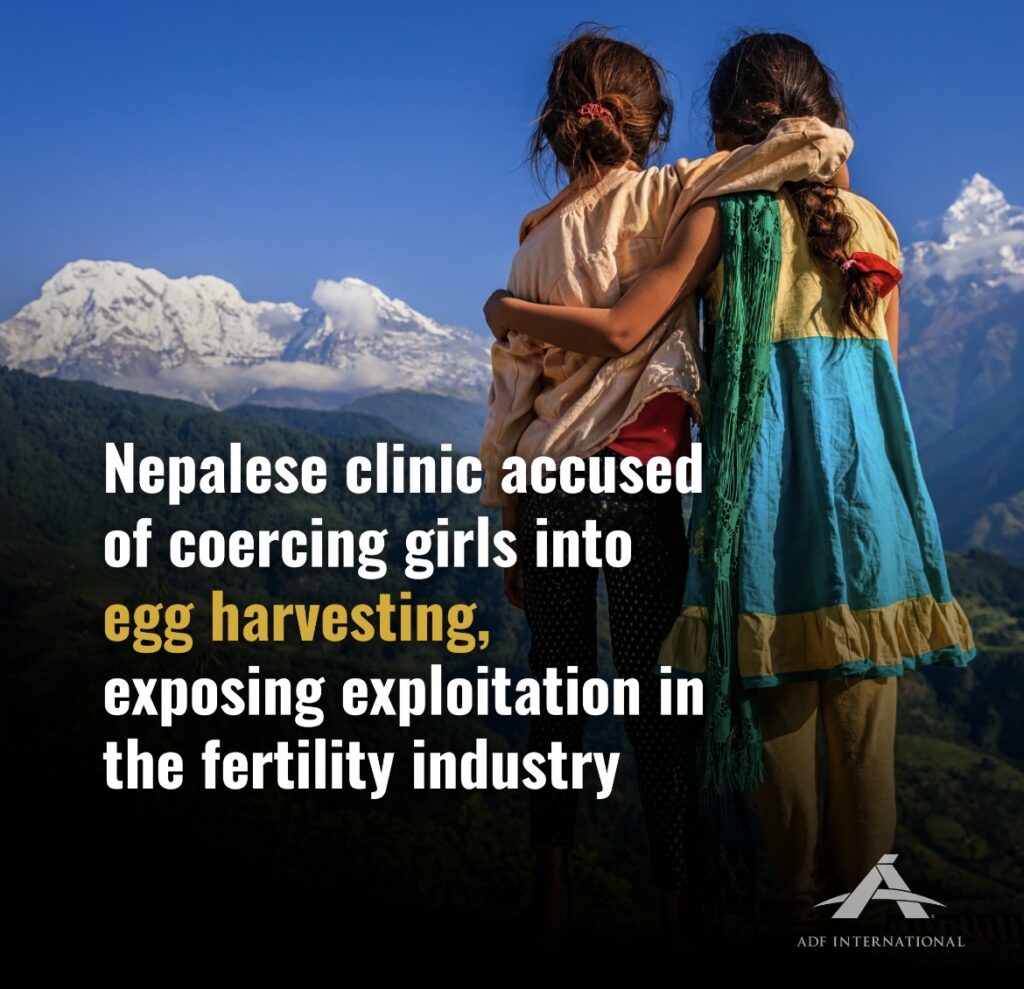
KATHMANDU (27 March 2026) — Young girls in Nepal reportedly have been subjected to coercive egg retrieval procedures in which their ova were harvested for use in fertility treatments, raising urgent human rights concerns. In August, the Supreme Court of Nepal was petitioned regarding the case of two girls and is expected to hold its final hearing on 30 March.
Petitioners, with the legal support of ADF International, have called on the Court to take immediate steps to protect vulnerable minors from fertility-related exploitation.
The petition, currently pending before Nepal’s highest court, states that the minors, both aged 17, were isolated from parental oversight, subjected to physical manipulation of their reproductive systems, deprived of food, rendered unconscious, and exposed to significant short and long-term health risks without a meaningful understanding of what was being done to their bodies or why.
The girls were transported, over a period of approximately ten consecutive days, to the Hope and Fertility Diagnostic Private Clinic in Kathmandu. Although no specific information is available on how the harvested eggs were to be used, the clear intention was to use them in assisted reproductive services.
Ova donation is often commercialized, with intended parents paying for eggs, and concerns have been widely raised about the heightened risk of exploitation in parts of the developing world where economic vulnerability can be leveraged.
Following the procedure, an individual associated with the harvesting clinic transferred NPR 10,000 (approximately 69 USD) to the bank account of a third party linked to one of the victims. The victims reportedly experienced excessive bleeding, loss of appetite, and psychological distress, leading their parents to file complaints with Nepal’s Human Trafficking Bureau and Criminal Investigation Bureau.
“What has happened to these Nepalese girls exposes the dark side of the fertility industry, especially in the developing world. The exploitation of minors through invasive egg retrieval procedures is deeply disturbing. The girls could never have given meaningful consent, and the apparent targeting, coercion, and medical abuse described in this case demand urgent scrutiny,” said Tehmina Arora, Director of Advocacy for Asia at ADF International.
“The Supreme Court now has a critical opportunity to recognise the gravity of these abuses and ensure that Nepal puts in place a clear and stringent legal framework to prohibit coercive reproductive procedures, sending a clear message that the exploitation of vulnerable girls will not be tolerated. The fertility industry must not be allowed to operate in violation of basic human rights”.
Previously, the Office of the Attorney General declined to initiate criminal proceedings, citing the absence of an explicit statutory prohibition for the practice of minor egg harvesting. The Attorney General further justified the decision not to prosecute by relying on the clinic’s IVF authorization and licensing validity, in addition to the view that the Nepalese Children’s Act does not explicitly categorize the alleged acts as violence or sexual abuse. The Attorney General also cited a lack of evidence that the girls were brought in against their will, even though minors cannot give meaningful consent to such procedures.
The Supreme Court has been petitioned to challenge both the decision of the Attorney General and the subsequent inadequate regulatory measures (the Standards for the Operation of Infertility Management Services) introduced by the government.
The petitioners have asked the Court to recognize these procedures as crimes against children, amounting to child trafficking, sexual violence, and reproductive exploitation. They seek urgent judicial intervention on the grounds that the alleged egg harvesting was carried out through inducement and deception of the minor girls.
Background
According to the petition before the Supreme Court, both girls were reportedly identified through advertisements on social media and then approached and influenced by agents who transported them to the clinic, where they were subjected to invasive hormonal stimulation and ova extraction.
The petition details that the medical practitioners closely monitored the girls’ menstrual cycles, conducted ultrasound examinations, follicle counts, hormonal testing, daily injections, and repeatedly gave the impression that the extraction was a simple procedure.
At no stage were the minors provided with accurate or age-appropriate information regarding the nature, purpose, risks, or potential consequences of the procedures, in violation of the Medical Council Code of Ethics of Nepal, which states that informed consent is a prerequisite for any medical intervention, and, for minors, the consent of a parent or legal guardian is mandatory. The procedures were carried out without the girls’ parents’ prior knowledge, and the girls’ and their parents’ identities were altered, and their ages were misrepresented in official documentation.
The first petition was filed before the Supreme Court of Nepal on August 18, 2025. It is supported by two additional petitions. The Court has been asked to assess these abuses in light of the Constitution of Nepal, the country’s criminal laws, and the Children’s Act, in addition to the principle of the best interests of the child.
“This case reflects the changing dynamics of human trafficking, where vulnerable young girls are exploited through reproductive abuse and treated as commodities for profit. We have urged the Court to recognize such acts as trafficking and reproductive exploitation. The interim ban is an important step, but justice will only be served when every perpetrator is held accountable, and every victim’s dignity is restored,” stated Dhruba Bhandari, advocate for the petitioners and allied lawyer of ADF International.
The Court has issued an interim stay on all further egg extraction processes for minors pending further orders.