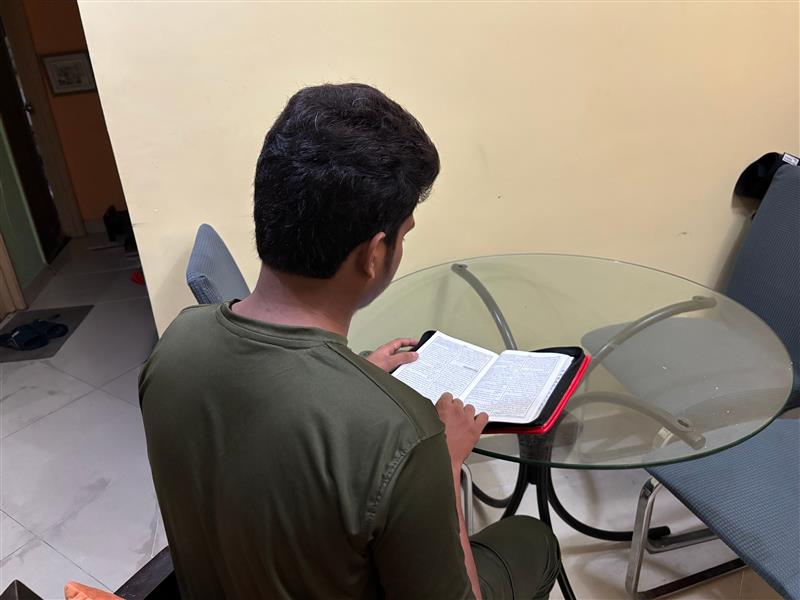

Akash Karamat, a now 19-year-old Christian who was a minor at the time of arrest, faces multiple fabricated blasphemy prosecutions in Pakistan. He was detained for 20 months, subjected to traumatic conditions, and remains under the shadow of criminal proceedings that carry the death penalty and life imprisonment. The charges are motivated by religiously-based hostility and were brought without any credible evidence. With fabricated charges still hanging over him, and extremists openly threatening his life, Akash faces significant security concerns due to the false blasphemy charges, threats of violence against his family, and constant risk of mob attacks.
Akash’s case exemplifies how Pakistan’s blasphemy laws are used to punish religious minorities and to silence dissenting speech, exposing him to a real risk of mob violence, extrajudicial killing, wrongful conviction, life imprisonment, and the death penalty. Alliance Defending Freedom is supporting his legal defense.
“Akash’s story shows in the clearest terms how blasphemy laws devastate lives and deny the most basic rights. No one should face prison, death threats, or the death penalty simply because of their faith. His case is a call to the international community to stand for justice and to defend freedom of religion and expression for all.”
Tehmina Arora, Alliance Defending Freedom’s Director of Advocacy for Asia
Case Summary
Akash Karamat, a then-17-year-old Christian student from Pakistan’s Punjab Province, was falsely accused of blasphemy in three separate incidents during the summer of 2023. In each case, local police first registered complaints against “unknown persons” after alleged desecrations of Islamic texts and posters. Only later—after pressure from extremists—was Akash suddenly named as the perpetrator. The allegations claimed he was connected to burnt pages of an Islamic prayer book left near mosques and a poster said to contain derogatory remarks about the Prophet of Islam and his family. No credible evidence has ever been produced linking him to the incidents, yet prosecutors pressed forward, exposing him to the death penalty under Pakistan’s harsh blasphemy statute.
Even after the Lahore High Court granted bail, Akash’s release was deliberately delayed for two more months due to impossible bail conditions imposed by the trial court. He finally regained his freedom in April 2025, but his ordeal was far from over. Ongoing prosecutions, threats from extremist groups, and the stigma of blasphemy accusations continue to endanger his life and the safety of his family, who already have been displaced and attacked, after violent mobs attempted to ransack their village home when news of Akash’s arrest in the fabricated blasphemy cases became public.
With fabricated charges still hanging over him and extremists openly threatening his life, Akash faces an immediate and severe security threat. There is little chance that he will receive a fair trial in the current climate of hostility and prejudice. Similar cases have shown that acquittals in blasphemy-related prosecutions do not guarantee freedom, forcing those who are cleared by the courts to remain in hiding, unable to live safely or move about freely in Pakistan without fear of reprisal. Many others are forced to flee the country.
Akash’s situation urgently calls for protection for him and his family so that he can live safely, continue his education, and rebuild a future free from fear.
Blasphemy laws threaten religious minorities
Akash’s case highlights the severe state of freedom of religion and expression in Pakistan. The charges against him were clearly motivated by his Christian faith, demonstrating systemic discrimination against religious minorities and the use of these laws to incite mob violence against them. International human rights law holds that no one should face imprisonment, persecution, or death for their beliefs. The international community has repeatedly called Pakistan to honour its international commitments.
Akash’s case is emblematic of how blasphemy laws in Pakistan are used to persecute religious minorities, silence free expression, and foster mob violence.
As of July 25, 2024, there were 767 people accused of blasphemy languishing in jails across Pakistan, whereas in 2023, there were 213 suspects incarcerated for blasphemy, 64 in 2022, nine in 2021 and 11 in 2020, according to the data gathered by the National Commission for Human Rights.
According to the Center for Social Justice, at least 104 persons were killed extra-judicially following blasphemy allegations between 1994 and 2024, which included 26 Christians (25 percent).
International pressure building on Pakistan
In January 2025, EU officials warned Pakistan of potential repercussions for its Generalized Scheme of Preferences Plus (GSP+) trade status due to persistent human rights concerns. EU Special Representative on Human Rights Olof Skoog reiterated that trade benefits hinge on tangible progress, including protection for minority rights and freedom of religion.
Earlier resolutions, including the European Parliament’s 2021 joint motion, condemned blasphemy laws, and urged an immediate review of Pakistan’s GSP+ status.
Alliance Defending Freedom is supporting Akash’s individual case while pursuing the broader objective of seeking the abolition of blasphemy laws so that no one else faces the threat of imprisonment, violence, or death for their faith.