Landmark Declaration Calls for International Moratorium on Surrogacy
- Joint political declaration calls for an international moratorium on surrogacy
- ADF International moderates launch event at the UN and welcomes sustained momentum towards the global abolition of the practice
GENEVA (22 JUNE 2026) – A group of states has today launched a political declaration calling for an international moratorium on surrogacy, as part of broader efforts to promote the abolition of the practice in line with international human rights law.
Spearheaded by the governments of Italy and Chile, the declaration sets out a shared commitment to achieving the global abolition of surrogacy, promoting an international moratorium on the practice as a stepping stone towards an international legally binding instrument.
The declaration highlights the severe human rights violations and abuses inherent in surrogacy, noting especially the commodification of human life and women’s reproductive capabilities, as well as the harm to the rights of children caused by their deliberate separation from the women who carried and gave birth to them.
The signatories of the declaration warn that women and girls involved in surrogacy arrangements face wide-ranging harms, including serious medical risks, coercion, exploitation and loss of agency – risks that fall disproportionately on vulnerable women and children with limited access to effective remedies.
They also raise urgent concerns about the impact of surrogacy on the early development and long-term health and wellbeing of children born through the practice. The declaration points to potential psychological, emotional, and identity-related impacts as well as complex legal challenges relating to parentage, nationality, and legal protection, and risks of abandonment, trafficking, and exploitation.
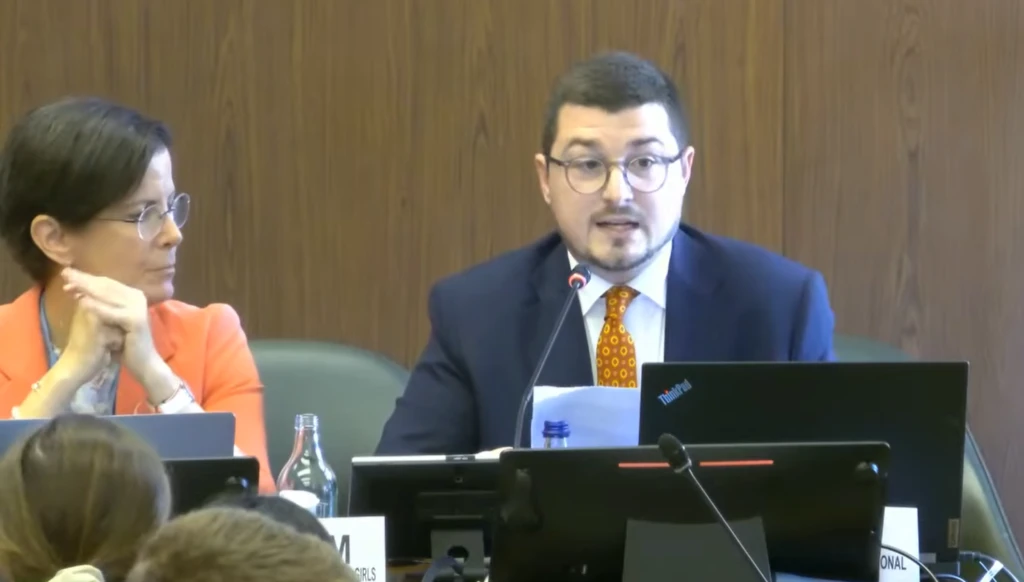
The document was presented at a high-level event held on the sidelines of the 62nd session of the UN Human Rights Council, co-hosted by the governments of Italy, Chile, Cameroon and the Holy See and moderated by ADF International.
The declaration was launched shortly before the UN Special Rapporteur on violence against women and girls, Reem Alsalem, presented a new report on violence against mothers to the Human Rights Council, which identifies surrogate mothers as being at particular risk of violence.
Speaking at the event, Eugenia Roccella, Italian Minister for Family, Natality and Equal Opportunities, said:
“Surrogacy is no longer a matter confined to domestic legislation or individual choices. It has become a global phenomenon, increasingly shaped by international markets, cross-border arrangements, and profound inequalities within and between societies. As policy-makers, we have a responsibility to ask a fundamental question: do we still recognize every human being as a person to be respected, or are we willing to accept situations in which human beings can become a means to satisfy the interests and desires of others?”
“The growing globalisation of surrogacy arrangements, particularly commercial and cross-border practices, has generated complex legal, ethical, and human rights questions,” said Felipe Kipreos Palau, Director of Human Rights of the Chilean Ministry of Foreign Affairs.
“Divergent national frameworks create regulatory gaps that may encourage the transfer of risks and harmful consequences across jurisdictions…These challenges call for an enhanced international cooperation, and for conversation grounded in the best interests of the child and the dignity of every person involved.”
Reem Alsalem, the UN Special Rapporteur on violence against women and girls, also expressed her support for the move:
“The states that are joining the declaration today recognise that surrogacy raises… fundamental concerns relating to human dignity [and] the commodification of women and children. They recognise that these concerns are not only limited to commercial arrangements, but that fragmented national approaches will facilitate the growth of a global cross-border market that transfers harm onto women and children in more vulnerable jurisdictions…This declaration shows that policy action is possible”.
“International law already supports the position that surrogacy is incompatible with human dignity and the rights of both women and children – yet its rapid expansion and cross-border loopholes demand a coordinated global response,” said Giorgio Mazzoli, Director of UN Advocacy at ADF International.
“Today’s declaration marks an important step forward in building the international consensus needed to confront the grave human rights violations and abuses inherent in the practice. We welcome the leadership of the sponsoring states and call on governments around the world to join this movement to protect women and children from an industry that profits from their vulnerability.”
Milestone for surrogacy abolition advocacy
The declaration is the latest milestone in the growing international movement towards the abolition of surrogacy, reaffirming the recommendations of a landmark UN report presented in October 2025.
In the report, the UN Special Rapporteur on violence against women and girlsconcluded that surrogacy is “characterized by exploitation and violence against women and children, including girls”, calling on the international community to work towards eradicating the practice through the adoption of an international legally binding instrument.
ADF International has been an early voice in calling attention to the human rights implications of surrogacy at the UN. In addition to providing expert testimony and speaking at multiple high-level events alongside government and UN officials, the organization was also among the driving forces behind a civil society letter endorsed by a diverse coalition of over 220 NGOs from 40 countries, calling for a coordinated international response to surrogacy.
In 2024, Italy became the first country to prohibit surrogacy both within and outside its borders, while in September 2025 Slovakia adopted a constitutional amendment prohibiting the practice. Most recently, in January 2026, the Family, Childhood and Adolescent Commission of the National Congress of Chile advanced landmark legislation that would prohibit surrogacy.