Finnish MP Päivi Räsänen submits testimony before Canadian Senate Human Rights Committee on C-9 “Hate Speech” Bill

Päivi reads her bible in the Finnish Parliament building.
  • Päivi Räsänen shares her experience of prosecution and conviction by Finnish authorities for peacefully expressing Christian beliefs about marriage and human sexuality
  • Räsänen submitted testimony as Canadian Senate considers amending criminal code to weaken protections for opinions expressed on religious subjects
Päivi reads her bible in the Finnish Parliament building.

OTTAWA (2 JUNE 2026) – Finnish parliamentarian Päivi Räsänen, who was criminally convicted for a decades-old church booklet about marriage and sexual ethics, was invited to submit a testimony before the Canadian Senate Human Rights Committee on the C-9 bill concerning “hate speech”.

In her testimony, submitted for the hearing on 1 June, Räsänen discussed her experience of facing a seven-year prosecution and three criminal trials for sharing her Christian beliefs about marriage on social media and in a booklet written for her church. Citing her narrow conviction by the Finnish Supreme Court, Räsänen warned the Committee of the dangers of removing protections for religious speech in the public square.

The former Interior Minister’s testimony comes as Canada’s House of Commons considers Bill C-9, which proposes to weaken protections for speech on religious matters in the Canadian criminal code.

The bill, among other things, removes a provision that protects religious statements made in “good faith”, potentially criminalising religious speech that would otherwise be lawful.

If passed, the bill would enable the prosecution of religious speech if the courts consider that it “wilfully promotes hatred against any identifiable group”. It carries a punishment of up to two years’ imprisonment.

“My experience in Finland has shown me that laws which criminalize speech have a very real cost not only to individuals, but also society at large. They encourage law-abiding citizens to censor their speech, and deprive wider society of conversations of critical importance."

In her testimony, Räsänen emphasised the dangers that “hate speech” laws pose for fundamental freedoms and democratic societies:

“Censorship is one of the greatest existential threats to today’s democracies in Europe. You do not need to agree with my beliefs to see the danger of criminalizing peaceful speech. When the state controls which ideas and beliefs may be expressed, democracy becomes fragile. My case reveals where this path can lead.

“My experience in Finland has shown me that laws which criminalize speech have a very real cost not only to individuals, but also society at large. They encourage law-abiding citizens to censor their speech, and deprive wider society of conversations of critical importance.

Räsänen further warned against ambiguous “hate speech” legislation that criminalises the peaceful expression of certain beliefs. She recalled the Finnish Supreme Court’s decision to uphold her conviction despite acknowledging that her booklet “did not contain incitement to violence or comparable threat-like fomenting of hatred”.

She added that censorial legislation has negative consequences both for those prosecuted and others who will no longer feel able to express their views:

“Even when courts ultimately acquit, our story shows how the process itself becomes the punishment. We have faced years of investigation, public scrutiny, and legal uncertainty. This creates a chilling effect, not just for Christians, but for everyone who holds views outside a narrow, state-approved consensus… Through fear, “hate speech” laws undermine public discourse and drive diverse views from the public square.”

Räsänen concluded: “I look forward to the day when the fundamental right to free speech is upheld for all who seek to peacefully express their convictions.”

Background

In March 2026, Räsänen was found guilty of “insult” by the Finnish Supreme Court for expressing her Christian beliefs about human sexuality in a 2004 booklet produced for her church. Lutheran Bishop Juhana Pohjola and the Luther Foundation Finland were convicted alongside her for publishing the booklet.

The long-serving Finnish parliamentarian’s nearly seven-year criminal prosecution began after she shared her Christian beliefs about marriage and sexual ethics in a 2019 tweet, leading to a police investigation that resulted in further charges for expressing her beliefs in a 2019 live radio debate and authoring the 2004 church booklet.

Formally charged with “agitation against a minority group” in 2021, Räsänen was acquitted on all charges by two lower courts in 2022 and 2023. Nevertheless, the state prosecutor appealed the decision concerning the Bible verse tweet and church booklet. In a narrow 3-2 ruling, the Finnish Supreme Court upheld the acquittal for the tweet but convicted Räsänen, the Bishop and the Luther Foundation Finland for the booklet.

In May, Räsänen announced her intention to appeal her case to the European Court of Human Rights, alongside Bishop Pohjola and the Luther Foundation Finland.

Images for free use in print or online in relation to this story only

Jim Demers: Justice Delayed and Overdue in Canada

Jim Demers is a Canadian pro-lifer who deserves justice.

The authorities have violated Canadian man Jim Demers' rights

Picture of Paul Coleman
Paul Coleman

Executive Director, ADF International

Jim Demers from Canada, ADF International client

Around the world, governments are enacting so-called “buffer zones”—restricted areas where the state dictates what can and cannot be said. These designated zones—incorporating public footpaths, bus stops, and even people’s homes—prohibit otherwise perfectly lawful activity from taking place within them.

They’re even being used to criminalize silent prayer in public places, as in the cases of Isabel Vaughan-Spruce and Adam Smith-Connor—two courageous UK citizens we’ve stood alongside.

As we’ll see, these restrictions on our lawful right to freedom of thought and expression have been going on for a long time. We want to introduce you to Jim Demers, a lifelong Canadian resident who has faced unrelenting opposition for his pro-life views.

Jim Demers' So-Called 'Crime'

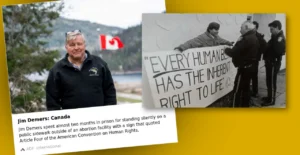
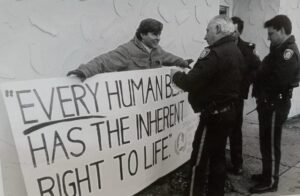
Back in 1996, Jim stood peacefully on a public sidewalk outside an abortion facility in Vancouver, holding a sign that quoted the American Convention on Human Rights:

“Every person has the right to have his life respected. This right shall be protected by law and, in general, from the moment of conception.” This peaceful act of expression led to Jim’s conviction as a criminal. He was imprisoned alongside violent offenders—all for exercising his right to free expression.

His so-called “crime”? Holding a pro-life sign within the “bubble zone” created by the Access to Abortion Services Act of British Columbia. Jim was convicted for “protesting against abortion services” and “sidewalk interference” inside the zone. But Jim didn’t speak to or interact with any members of the public or staff at the abortion facility, nor did he obstruct access to the facility in any way.

You are currently viewing a placeholder content from YouTube. To access the actual content, click the button below. Please note that doing so will share data with third-party providers.

More Information

Censorship Zones Silence Pro-Life Viewpoints

We can all agree that harassment is wrong. Indeed, in many countries that have introduced these buffer zones, harassment is already illegal. These zones are about silencing pro-life viewpoints in the exact place where a pro-life viewpoint might be needed the most. 

Both international law and the Canadian Charter of Rights and Freedoms guarantee the fundamental right to freedom of expression. Yet the unjust and discriminatory Act under which Jim was convicted still stands to this day—nearly 30 years later.

The shrinking space for free speech in Canada results from such laws being left to stand for decades, creating the false impression that these restrictions are legitimate. Let us reiterate to you today that they are not.

Jim brought his case to the Inter-American Commission on Human Rights in 2004. Twenty years later, the Commission still has not delivered a judgment, choosing instead to simply sit on his case. This is arguably the most severe case of an alleged backlog at any international human rights body.

Conclusion: We Will Stand with Jim Demers and He Deserves Justice

Now, we are standing with Jim. We have reactivated his case and are calling on the Commission to finally rule that Canadian authorities violated his rights. This case isn’t just about Jim—it’s about protecting the freedom of every person to express themselves without fear of criminal prosecution.

If international law and the Canadian Charter of Rights and Freedoms mean anything, then Jim’s rights—and the right of every person to free expression—must be defended.

“I hope I’m never silent when bad things are happening, and I hope nobody else is silent either when bad things are happening. I have dedicated my life to speaking out in defence of the unborn, and because of this, I was criminally convicted and even spent time in jail.” Jim’s courage reminds us that silence is never an option when freedoms are at risk. He deserves justice, no matter how delayed.

International body to rule on case of Canadian man who spent time in prison for holding sign outside abortion facility almost 30 years ago

  • Jim Demers was criminally convicted and spent almost two months in prison in 1996-97 for holding a sign quoting the American Convention on Human Rights: “Every person has the right to have his life respected” 
  • With no recourse left in Canada, Demers filed for redress with the Inter-American Commission on Human Rights in 2004 and has waited twenty years for justice.  
  • ADF International now representing Demers after 20-year wait: “As we grapple with the spread of censorship across the globe, this case presents an opportunity for a key human rights watchdog to reassert the very rights they were established to defend” 

WASHINGTON, DC (21 November 2024) Jim Demers, a lifelong resident of British Columbia, Canada, was criminally convicted and spent almost two months in prison in 1996-97 for standing silently on a public sidewalk outside of an abortion facility. He held a sign quoting Article Four of the American Convention on Human Rights: “Every person has the right to have his life respected. This right shall be protected by law and, in general, from the moment of conception.”  

Demers was standing in a censorship zone around the facility, which bans expression critical of abortion. 

Demers was criminally convicted for his peaceful expression, for which he was given a suspended sentence of two years, subject to the condition of not returning to the public area surrounding the abortion facility. 

After failing to obtain redress from the Canadian Supreme Court, Demers took his case to the Inter-American Commission on Human Rights in 2004. The Commission admitted his case in 2006, but almost 20 years later, has yet to rule.  In the face of this egregious failure to deliver timely justice, ADF International assumed representation of Demers.  

I hope I’m never silent when bad things are happening, and I hope nobody else is silent either when bad things are happening. I have dedicated my life to speaking out in defense of the unborn, and because of this, I was criminally convicted and even spent time in jail,” said Demers.  

“I have waited for almost 20 years for the Inter-American Commission on Human Rights to rule on my unjust conviction over the exercise of my freedom, and that of all people, to stand up, speak truth, and defend those that cannot defend themselves. I am grateful to ADF International for its efforts to bring this ordeal to an end. I will continue to advocate for the right to life of every person and look forward to the day when I can speak up without fear of criminal prosecution and punishment in Canada.”  

“All human rights are in peril when the fundamental right to free speech is ignored,” stated Tomás Henríquez, lead lawyer on this case for ADF International. “For peacefully expressing his pro-life views on a sidewalk outside of an abortion facility, Jim Demers was convicted as a criminal and forced to spend time behind bars with serious felons. Even if you disagree with Jim’s beliefs, everyone should defend his right to voice them without fear of criminal prosecution and imprisonment. Now is the time for the Inter-American Commission to exercise its authority to deliver justice for Jim.” 

“All human rights are in peril when the fundamental right to free speech is ignored.” 

Demers stood outside of an abortion facility in Vancouver, British Columbia before Christmas of 1996, holding a sign quoting Article Four of the American Convention on Human Rights. The Access to Abortion Services Act of British Columbia, in force to this day, establishes so-called “bubble zones” around abortion facilities, creating a censorship zone that bans free expression. Notably, the law imposes viewpoint discrimination, as it only penalizes expressions that are critical of abortion, but not others.  

Demers stood silently on the sidewalk outside of the main entrance, never engaging verbally or otherwise with any member of the public or of the abortion facility, or impeding entrance to the facility in any way.  

For this peaceful expression, Demers was arrested, placed in jail pending trial for seven weeks, alongside violent criminals, and was ultimately convicted on criminal charges. 

Demers filed a petition against Canada in 2004 with the Inter-American Commission on Human Rights. The Commission agreed to rule on the merits of his case in 2006 as to whether it was lawful to use criminal sanctions against Demers for his peaceful expression. Almost twenty years later, the Commission has yet to decide his case, in what is perhaps the most egregious case of alleged backlog at any international human rights body.   

“ADF International is proud to stand with Jim as he seeks justice in his case at the Inter-American Commission on Human Rights. The Commission has slept on Jim’s case for almost 20 years. We call on the Commission to rule decisively that these actions by Canadian authorities violated Jim’s fundamental right to freedom of speech,” Henríquez continued.  

“Both international law and the Canadian Charter of Rights and Freedoms guarantee the fundamental right to freedom of expression. As we grapple with the spread of censorship across the globe, this case presents an opportunity for our human rights watchdogs to reassert the very rights they were established to defend.”

Images for free use in print or online in relation to this story only.