
Acquittal for Päivi Räsänen’s 2019 Bible verse tweet unanimously upheld; Räsänen and Bishop Juhana Pohjola found guilty in 3-2 decision for expressing their faith-based beliefs in a church pamphlet
Continue readingEU Appoints New Special Envoy for Freedom of Religion or Belief After Year-long Vacancy
Mairead McGuiness is the new EU Special Envoy for the Promotion of Freedom of Religion or Belief (FoRB) outside the EU
Continue readingChristian Father Targeted by Pakistan’s “Blasphemy Business Group” Faces Possible Death Penalty
Christian sanitation worker falsely accused under Pakistan’s blasphemy laws and imprisoned for over 3 years could receive the death penalty; ADF International supports his defence
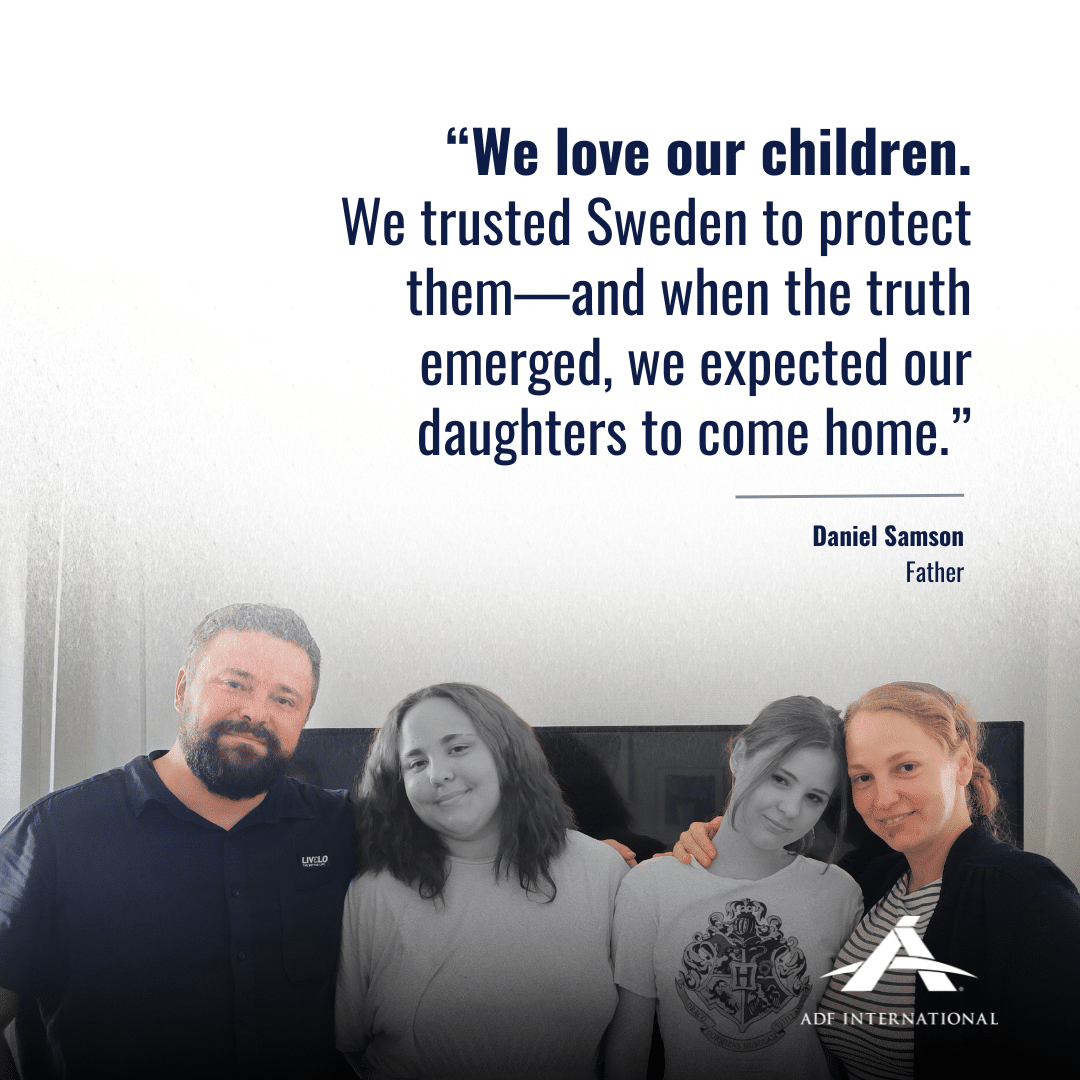
Continue readingEurope’s Top Court Rejects Case of Christian Parents in Sweden Seeking Reunification with Daughters after 3 Years Separation
The daughters have been separated from their parents, and each other, since December 2022, absent any evidence of abuse, and despite deteriorating health conditions in foster care and repeated wish to be reunited.
European Court of Human Rights deems case inadmissible on the grounds of failure to exhaust legal remedies in Sweden.
STRASBOURG (10 March 2026) – The European Court of Human Rights (ECtHR) has ruled a case brought by Christian parents Daniel and Bianca Samson against Sweden as inadmissible. The parents were seeking justice before the court to regain custody of their daughters, claiming a severe violation of their parental rights. The decision of inadmissibility is final and cannot be appealed. ADF International lawyers are now reviewing the decision together with the parents and assessing possible next steps.
The two eldest daughters of the Samson family were taken by the state in December 2022 after the eldest made a false report at school over her parents’ refusal to give her a phone and allow makeup, prompting allegations of “religious extremism,” even though she promptly retracted. The daughters have been separated from their parents, and each other, since December 2022, even though the state found no evidence of abuse.
“Parents have the primary responsibility and right to raise their children. When the state interferes with family life based on values-based parenting choices or discrimination on the basis of faith, fundamental freedoms are at stake."
- Guillermo A. Morales Sancho, Legal Counsel for ADF International
“We deeply regret the Court’s decision to reject this case, considering that this family has been torn apart for over three years despite a full investigation that cleared Mr. and Mrs. Samson of any abuse and the fact that the Social Services certified their capacity and fitness for parenting after they successfully completed an official training. Families should be free to live according to their convictions without fear of losing their children to the state,” said Guillermo A. Morales Sancho, Legal Counsel for ADF International.
The European Court of Human Rights deemed the case inadmissible on the grounds of failure to exhaust legal remedies in Sweden, despite the legal team’s assessment that there were no further options for domestic recourse.
Specifically, the Court indicated that it did not consider there to be an apparent violation of the right to respect for private life under the European Convention on Human Rights. It further suggested that questions relating to freedom of religion may be raised before national courts, an option the Samsons may now pursue.
Background
The couple of Romanian origin, who had been residing in Sweden for close to a decade, claim that Swedish authorities ignored the best interests of their children by refusing to reunite the family. The forced separation continued even after all allegations against the parents were dropped and prosecutors found no evidence of abuse. The case raises serious concerns about delays, overreach, and possible discrimination against Christians in Sweden’s child welfare system. The state has cited the family’s regular attendance at church three times a week to corroborate accusations of “religious extremism,” despite the fact that this simply reflects their religious beliefs and is a protected action under international human rights law.
The Samsons currently are only allowed one supervised visit per month. This is complicated by the fact that the girls are placed in different foster care homes far away from each other.
See our case page for more information: https://adfinternational.org/cases/samson-family
U.S. Commission on International Religious Freedom condemns targeted expulsions of Christians in Türkiye
- USCIRF releases statement urging US government action following Türkiye’s targeted deportations of Christian missionaries; recommends country be added to Special Watchlist for severe religious freedom violations.
- ADF International applauds push to protect religious freedom and is legally supporting the cases of Christians who have been banned from Türkiye.
WASHINGTON, D.C. (Feb. 27) – Yesterday, the U.S. Commission on International Religious Freedom (USCRIF) released a statement condemning the targeted expulsion of Christians in Türkiye. Recently, the European Court of Human Rights (ECtHR) took up twenty cases of Christians who have been designated as national security threats and expelled from the country by the Turkish government. The USCIRF statement recommends that the U.S. Department of State place Türkiye on its Special Watch List for severe violations of religious freedom.
These cases, almost all supported by ADF International, stem from the Turkish government’s use of internal security codes to label foreign Christian missionaries as threats to national security, blocking them from entering or remaining in the country despite long-standing lawful residence.
“Türkiye’s arbitrary labeling of foreign-born Protestant Christians as national security threats is meant to intimidate the Christian community and prevent them from gathering for worship. Everyone, regardless of residency status, has the right to freedom of religion or belief under international law,” said USCIRF Chair Vicky Hartzler. “The U.S. administration should maintain the momentum President Trump made in his September meeting with President Erdoğan and push for tangible improvements to Türkiye’s religious freedom record, including an end to its repressive tactics against Christians.”
“We hope that the U.S. government and the international community will continue to stand up for this fundamental right and call on Türkiye to put an end to the targeted expulsions of Christian missionaries. Peacefully practicing the Christian faith is no reason to be labelled as a security threat and expelled from the country these individuals lawfully built their lives in.”
- Kelsey Zorzi, Director of Advocacy for Global Religious Freedom at ADF International
The statement echoes a recent resolution from the European Parliament condemning the targeted expulsions from the country “carried out under unsubstantiated national-security pretexts and without due process” for foreign Christians, in addition to journalists. The Turkish government swiftly dismissed the resolution as containing “unfounded allegations” and characterized it as interference in the country’s internal affairs.
“We applaud USCIRF’s decision to speak out on the egregious violations of religious freedom we are seeing in Türkiye,” said Kelsey Zorzi, Director of Advocacy at ADF International. “We hope that the U.S. government and the international community will continue to stand up for this fundamental right and call on Türkiye to put an end to the targeted expulsions of Christian missionaries. Peacefully practicing the Christian faith is no reason to be labelled as a security threat and expelled from the country these individuals lawfully built their lives in.”
Background
Since 2019, Turkish authorities have issued internal security codes like “N-82” and “G-87” to target hundreds of foreign Christians, preventing them from re-entering Türkiye after trips abroad or denying them residence permits. These measures have affected at least 160 foreign workers and their families, many of whom lived and served in Türkiye for decades.
The government’s use of these codes effectively labels individuals as a “threat to public order and security,” a classification normally reserved for terrorism suspects. However, those targeted have no criminal records or evidence of unlawful conduct. The only thing that they have in common is openly practicing and sharing their Christian faith.
The 2024 Human Rights Violation Report presented by the Protestant Church Association records 132 people who have been arbitrarily branded with an entry ban code, preventing them from entering Türkiye solely on the basis of their Christian faith. The total number of those affected is 303, according to the report.
Reports of similar measures affecting many foreign Protestant Christians show that these cases are not isolated, but point to a wider pattern of systemic discrimination. The cases raise serious questions about fundamental rights protected under the European Convention on Human Rights.
Among those affected are long-term residents such as Pam and Dave Wilson, who served in Türkiye for almost forty years before being barred from returning; Rachel and Mario Zalma (pseudonyms to preserve anonymity), whose ministry work led to an N-82 designation after attending a church conference; and David Byle, a Christian minister forced into exile after 19 years of service.
These bans have not only separated families from the communities they helped build, but also left local churches without stable leadership, weakening the already-small Christian presence in a country where Christians make up a small fraction of the population.
ADF International has supported a number of these cases over several years, and directly represents four individuals before the ECtHR, two of whom are lead applicants, and has supported the majority of the other cases.
You are currently viewing a placeholder content from YouTube. To access the actual content, click the button below. Please note that doing so will share data with third-party providers.
More InformationTurkish Government Denies Targeted Deportation of Christian Missionaries; Accuses European Parliament of ‘Interference’
- Turkish Foreign Ministry dismisses overwhelming 502–2 vote as “baseless,” despite mounting scrutiny over expulsions of Christian missionaries from the country
- European Parliament voted to condemn use of Turkish security codes to expel Christians; this followed European Court of Human Rights recent decision to take 20 cases of missionaries expelled from Türkiye; the majority of which are legally supported by ADF International
Strasbourg (17 February 2026) — The Turkish government has formally rejected the European Parliament’s recent resolution condemning targeted expulsions from the country “carried out under unsubstantiated national-security pretexts and without due process” for foreign Christians, in addition to journalists.
In a statement issued on 13 February, a day after the vote, Türkiye’s Ministry of Foreign Affairs dismissed the resolution as containing “unfounded allegations” and characterized it as interference in the country’s internal affairs.
The European Parliament adopted the resolution by an overwhelming margin (502 votes in favor and 2 against) signaling broad cross-party concern over what lawmakers described as the misuse of national security frameworks to restrict fundamental rights, including freedom of religion. The resolution followed the European Court of Human Rights’ decision at the beginning of February to take up 20 cases involving foreign Christians who were expelled or banned from re-entering Türkiye.
These cases, the majority of which are supported by ADF International, stem from the Turkish government’s use of security codes, typically reserved for terrorist activity, to designate peaceful foreign Christian residents as threats to national security and block them from entering or remaining in the country despite longstanding lawful residence. The missionaries deported come from several countries across Europe, including the United Kingdom, Switzerland, and Germany. More than a dozen are originally from the United States.
“The Turkish government’s rejection of the European Parliament’s vote shows a clear lack of respect for its human rights obligations.When a government weaponizes national security mechanisms to target peaceful missionaries and faith communities, they must not be allowed to act with impunity.”
- Kelsey Zorzi, Director of Global Religious Freedom at ADF International
European Parliament addresses expulsion of missionaries
The European Parliament resolution specifically addresses the expulsion of foreign Christian missionaries, all legally residing in the Türkiye and many of whom were long-term residents of the country, through security codes that have resulted in deportations, re-entry bans, and loss of residency status. Lawmakers raised concerns about the lack of transparency, limited judicial review, and restricted access to evidence in these cases.
During the debate on the resolution European Member of Parliament Sokol (EPP) stated:
“These deportations of Christians in Türkiye for reasons of national security are one more attack on Christians, the most persecuted religious minority around the world. (…) The EU cannot talk of human rights and then remain silent when Christians are facing problems in Africa or persecution in a neighboring country. We must stand up for freedom of religion everywhere without any double standards. (…) Türkiye must put a stop to these deportations of Christians.”
Cases of Expelled Christians Now Before the European Court of Human Rights
The 20 pending cases before Europe’s top human rights court challenge the compatibility of the security-based expulsions with human rights protections for religious freedom, family life, and due process under the European Convention on Human Rights.
The government’s use of these codes effectively labels individuals as a “threat to public order and security,” a classification normally reserved for terrorism suspects. However, those targeted have no criminal records and no evidence of unlawful conduct—the only thing that they have in common is openly practicing and sharing their Christian faith.
The 2024 Human Rights Violation Report presented by the Protestant Church Association records 132 people who have been arbitrarily branded with an entry ban code, preventing them from entering Türkiye solely on the basis of their Christian faith. The total number of those affected is 303, according to the report.
ADF International provides legal support to affected individuals seeking justice before the European Court of Human Rights and calls on Turkish authorities to ensure that security measures are applied consistently with international human rights obligations.
Top European Court Takes Up Cases of Christians Banned from Türkiye
- European Court of Human Rights formally communicates 20 cases of Christians banned from Türkiye solely for living out their faith
- ADF International supports 17 cases, highlighting serious, systemic human rights concerns
Strasbourg (5 February 2026) — The European Court of Human Rights (ECtHR) has formally taken up and “communicated” 20 cases brought by Christians whom Türkiye effectively banned from re-entry solely for living out their faith.
These cases — almost all supported by ADF International — stem from the Turkish government’s use of internal security codes such as “N-82” to label peaceful foreign Christian residents as threats to national security, blocking them from entering or remaining in the country despite long-standing lawful residence.
Since 2019, Turkish authorities have issued internal security codes like “N-82” and “G-87” to hundreds of foreign Christians, preventing them from re-entering Türkiye after trips abroad or denying them residence permits. These measures have affected at least 160 foreign workers and their families — estimated to be hundreds of individuals — many of whom lived and served in Türkiye for decades.
The ECtHR has jointly communicated these cases to the Turkish Government, indicating that the Court considers the applications sufficiently related to be examined together and has proceeded to posing questions to the parties.
“Peaceful worship and participation in church life are not threats to national security. Yet foreign Christians in Türkiye — pastors, teachers, ministry workers, and missionaries — have been labelled security risks and expelled based on undisclosed files,” said Dr. Lidia Rider, Legal Officer for ADF International. “Deprived of access to the allegations, they had no meaningful opportunity to defend themselves in courts. The Court’s communication of these cases is a crucial step toward accountability and redress.”
Discrimination Behind the Numbers
The government’s use of these codes effectively labels individuals as a “threat to public order and security,” a classification normally reserved for terrorism suspects. In practice, however, those targeted have no criminal records and no evidence of unlawful conduct — the only thing that they have in common is openly practicing and sharing their Christian faith.
The 2024 Human Rights Violation Report presented by the Protestant Church Association records 132 people who have been arbitrarily branded with an entry ban code, preventing them from entering Türkiye solely on the basis of their Christian faith. The total number of those affected is 303, according to the report.
Reports of similar measures affecting many foreign Protestant Christians show that these cases are not isolated, but point to a wider pattern of systemic discrimination. The cases raise serious questions about fundamental rights protected under the European Convention on Human Rights — including freedom of religion, family life, and protection from discrimination — and highlight the need for clear, evidence-based decisions when governments invoke public order or national security, especially given the severe disruption these sudden and unexplained bans have caused to long-term residents and their families.
Real People, Real Consequences
Among those affected are long-term residents such as Pam and Dave Wilson, who served in Türkiye for almost 40 years before being barred from returning; Rachel and Mario Zalma (pseudonyms to preserve anonymity), whose ministry work led to an N-82 designation after attending a church conference; and David Byle, a Christian minister forced into exile after 19 years of service.
These bans have not only separated families from the communities they helped build but also left local churches without stable leadership, weakening the already-small Christian presence in a country where Christians make up a tiny fraction of the population.
A Longstanding Effort to Expose Systemic Abuse
Over several years, ADFI has raised awareness of these human rights violations through, among other activities, workshops with local lawyers, academic publications and expert submissions highlighting systemic violations of freedom of religion or belief and related rights.
ADF International has supported a number of applicants and counsel in these cases over several years. ADF International directly represents four individuals before the Court, two of whom are lead applicants, and has supported nearly all the other cases.
“We welcome the Court’s decision to jointly communicate these cases. These are not isolated mistakes or one-off decisions,” said Kelsey Zorzi, Director of Global Religious Freedom for ADF International. “By examining these cases together, the Court is acknowledging that they may reveal a pattern of discrimination against Christians in Türkiye. We look to the Court to uphold the fundamental principle that governments cannot strip people of their rights simply for living out their faith.”
Images for free use in print or online in relation to this story only
Pictured: Dave and Pam Wilson; David Byle; Lidia Rieder; Kelsey Zorzi
10 Years On: Recognition of ISIS Genocide Must Lead to Renewed Action to Protect Religious Minorities
Today, the international community marks the tenth anniversary of the 2016 recognition of the genocide committed by ISIS against Christians, Yazidis, and other religious and ethnic minorities in Syria and Iraq by the European Parliament.
Continue readingEuropean Court Case May Determine the Future of Religious Symbols in Public Institutions
ADF International intervenes to defend display of Christian symbols in public buildings: “There is no incompatibility between the display of religious symbols and human rights law.”
Ruling could affect public institutions across 46 Council of Europe states
Egypt Grants Paid Easter Leave to Christian Workers, Marking Step Forward for Religious Freedom
New decision allows paid religious leave on Easter for Christian employees under Egypt’s Labor Law
ADF International supports an ongoing petition seeking full recognition of Easter Sunday as a national public holiday