The Finnish Line: The Supreme Case of Päivi Räsänen After 6 Years

Päivi Räsänen’s case has been ongoing for 6 years. Now her fate rests at the Finnish Supreme Court

A Nation Watches as One of Its Most Respected Leaders Goes to the Supreme Court for Speaking Her Faith
Päivi Räsänen’s case has been ongoing for 6 years. Now her fate rests at the Finnish Supreme Court
Update Sept. 2025: The Finnish Supreme Court has set the date for an oral hearing on 30th October 2025.

The case of Finnish MP Päivi Räsänen is more than a legal battle; it’s a test of Europe’s commitment to democratic values.

As one of Finland’s most respected politicians, Päivi now faces the Finnish Supreme Court for peacefully expressing her Christian beliefs online.

Her story is a powerful reminder of what it means to be a Christian in today’s pervasive culture of censorship. It also demonstrates unwavering faith in the face of prosecution and punishment for so-called “hate speech”.

ADF International is proud to stand alongside Päivi as her legal ordeal reaches its 6th year.

A Life of Conviction

Päivi was still a very young girl when her parents decided she could go to the church in their small village of Konnunsuo, just inside the Finnish border from Russia. It’s a region known for hundreds of beautiful lakes and one less beautiful prison, where Päivi’s father worked, tending the gardens. While he and his wife were not Christians, they respected the faith and didn’t feel it would do little Päivi any harm to learn a bit of the Bible.

Time would prove them both wrong and right about that, but as a child, Päivi was fascinated with the things she learned in those Sunday morning classes.

“It was very, very affecting and important for me,” she remembers, nearly six decades later. “I was about 5 or 6 years old, and I remember well, even at that age, those talks the teachers shared with us about Jesus.”

Biblical concepts like grace and sin, salvation and judgment, she says, “were so concrete. Even as a small child, you have to think about these issues. And I remember praying that I would have my sins forgiven, and that Jesus would come into my life.”

How seriously Päivi took her new conversion became clear shortly afterward, when the prison warden came riding along the road by her family’s house on his bicycle. She urgently waved for him to stop. He did, looking down into her big, earnest, little-girl eyes to ask what was wrong.

“Do you love Jesus?” she asked. “You can’t get to heaven if you do not know Him.”

Embarrassed, the warden looked around and saw Päivi’s mother, standing nearby. “You should take your baby out of that Sunday school today!” he yelled. “Before she loses her mind!”

If her mother was concerned about her husband’s boss’s opinion, she didn’t show it. Päivi stayed in Sunday school. But it was by no means the last time Päivi spoke up for her faith. Or drew sharp opposition for doing so.

The Start of Päivi’s Career

Although she went to the University of Helsinki to study medicine, Päivi spent at least as much time there sharing her faith. For five years, she led a student missionary group in weekly door-to-door visits around campus, drawing other young people into discussions about moral values and cheerfully engaging them with the Gospel of Jesus Christ.

“It was an important time in my life,” she remembers, “an important schooling. Every week, I was discussing quite difficult issues with students from different backgrounds and areas of study. I had to think very thoroughly about how my faith stands — how the Bible stands — in the face of these difficult questions. I learned to discuss ideas. I learned to debate.”

Her extracurricular evangelism also changed her life in another way. Twice during those years, Päivi joined other Christian students from all over Finland on mission trips to London, led by a tall, smiling young man named Niilo Räsänen.

He and Päivi took a shine to each other, began to date, and soon were married. They went on to raise four daughters and a son, as Niilo became a pastor in the Evangelical Lutheran Church and head of one of the denomination’s seminaries.

Päivi, meanwhile, went into general practice medicine. She quickly developed a reputation as both an excellent doctor and a thoughtful, outspoken defender of life.

“I had decided already during my studies that I would not end the life of a child in the womb,” she says. In her spare time, she wrote books and pamphlets on the subject. That led to television and radio appearances, where she drew on those debate skills she’d honed back in college. Her strong, winsome arguments began to attract wide attention. People asked if she was interested in standing for office — perhaps campaigning for a seat in Parliament.

“At first I refused,” she says. “I thought it was not my place.” But people continued to urge her to run … and one of those urging was her husband.

“Actually, I think I was the first,” Niilo says. “But she wasn’t interested.” One day, though, he drove her through Helsinki, past the building where Parliament met. He pointed at the building. “Look at your future workplace,” he told her.

The 1990s brought a severe economic recession to Finland. Päivi’s patients were hit hard by what was happening and often poured out their worries to her.

“I could see a lot of problems in people’s lives,” she says — problems born of what was happening in her country’s politics and culture. “I thought I would like to try and influence the society and improve the welfare of the people. To not only give them medicine, but to try to heal the consequences of these problems.”

A person in Parliament could do that, she decided. The next time someone suggested she stand for office, Päivi was ready. “I answered, ‘Yes.’”

Päivi as a Parliamentarian

Päivi Räsänen has served continually in the Finnish Parliament since 1995. For 11 of those years, she acted as chairman of the Christian Democrats, a party she chose for its support of her Christian values and unswerving opposition to abortion. For four years, she also served as her nation’s minister of the interior, overseeing internal national security and migration issues.
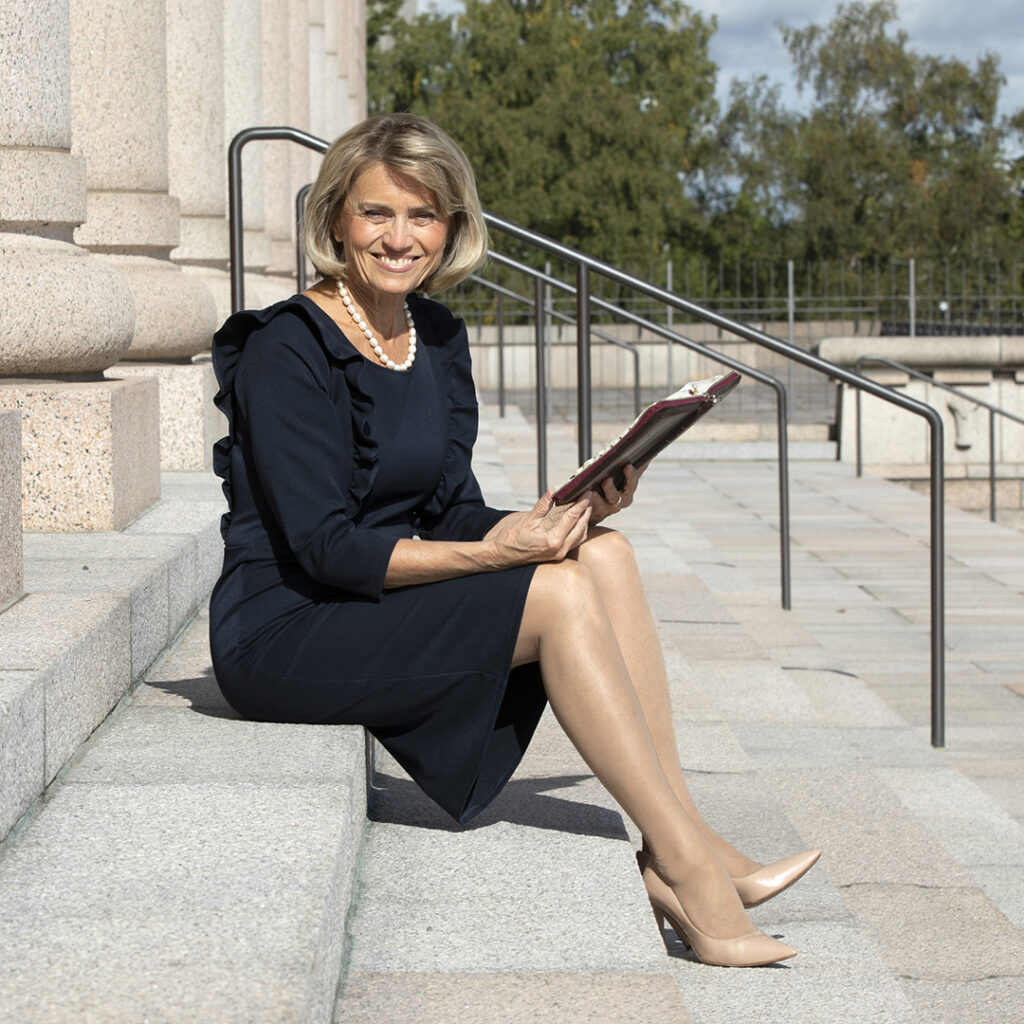
Päivi reading her Bible at parliament

“I have felt, very deeply, that this has been my calling,” she says. “I’ve been happy to have the opportunity to influence our society, our country, and to try to make better living conditions for people, especially families and children and the elderly.

“In some ways, it is very similar to working as a doctor. People come to you to talk about their problems, and then you try to find some solution. That’s been my work in Parliament.” She’s learned, she says, that “politics is one way to show love to your neighbour.”

You might think that attitude would have enhanced Päivi’s interactions with Finland’s religious leaders — “church affairs” was another aspect of her responsibilities as minister of the interior, and her work brought her into contact with most of the prominent clerics of her country.

Still, even knowing these leaders so well, she was stunned to learn, in the summer of 2019, that the Evangelical Lutheran Church of Finland — her own denomination and the one in which her husband served as a pastor — had pledged its full support for an upcoming Helsinki Pride event.

“I knew that our church at that time was already quite divided,” Päivi says, “and there was a lot of progressive liberal thinking among our pastors.” Still, “that the whole church leadership had decided to support the event, publicly and financially, was a strong disappointment to me — and to many other Christians.”

Many friends confided to her their intention to resign from the church. Päivi seriously considered joining them. “I was praying, ‘What should I do now? Should I leave the church, too?’”

The Tweet That Sparked a Trial

But, on her knees, her Bible open before her, “I received a very clear vision,” Päivi says, “that now was not my time to jump out of this sinking boat — that I should try to wake people up. I was especially worried about our young people losing their trust in the Bible, with the leadership of the church teaching something so much against what the Bible teaches.”

“What the Bible teaches.” After a moment, she reached for her cell phone, turned to Romans 1:24-27, and snapped a photo. She pulled up her X (formerly Twitter) account, attached the picture, called it to the attention of the Evangelical Lutheran leadership, and added one simple question:

“How does the doctrine of the church, the Bible, fit together with the fact that shame and sin are raised as a matter of pride?”

She pressed “Tweet.”

And her life changed, forever.
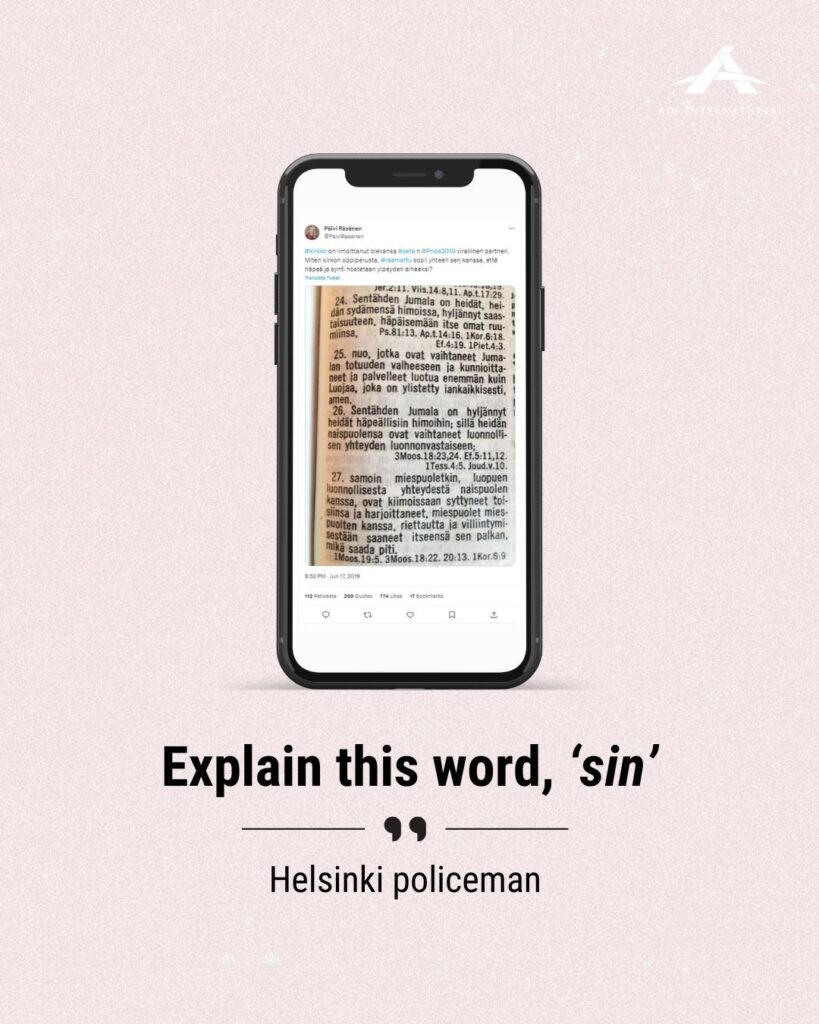
Explain this word, 'sin', she was asked.

Päivi’s communique thoroughly rocked “the boat” and woke up everyone in it. Including Päivi.

A few weeks after she had posted the tweet, she opened a newspaper and read — to her astonishment — that local police had received a complaint about her message and were investigating. Their evidence would determine whether the nation’s chief prosecutor would bring her to trial for her beliefs.

“At first, I didn’t believe it,” Päivi says. “I thought, ‘No, no, this must be from a summer intern who doesn’t know what he’s saying.’” But a call to her local precinct confirmed that officers were indeed looking into the matter. When could she come in and speak with them?

Over the next few months, Päivi would be required to sit for a total of 13 hours of police interrogation.

“It was an absurd situation,” she remembers, “sitting there in a small room in the station, being interrogated about my Christian beliefs.” The policeman asking questions kept an open Bible on the table between them. He pointed at it as he probed her theology: “What is Romans about?” “Tell me about the first chapter.” “Walk me through Genesis.” “Explain this word, ‘sin.’”

Päivi found the whole thing almost laughable. “Just a few years before, I was the [cabinet] minister in charge of police, and now I was sitting here, being interrogated.” But the people of Finland understood what was happening: one of the most well-known political figures in their country was being detained at police headquarters for quoting Scripture to bishops.

“Someone joked on social media that maybe we were going to have Bible studies at the police station,” Päivi says, smiling. “But … these discussions were very good. I had the opportunity to [share with] that policeman very thoroughly the teachings of the Bible, from Genesis to the message of the Gospel … because he asked me to.

“Do you really want to hear this?” she asked him. “Because this has been such an important book to me. When I read it, I understand the message of the Gospel: that Jesus has died for my sins.”

“It was lovely,” she says, smiling, “telling that to the policeman.”

She left an impression. “If it were up to me,” he told her, after their last discussion, “you wouldn’t be sitting here. I hope we don’t have to meet like this again.”

Charged With “Hate Speech”

They didn’t. But Päivi had to wait more than a year to learn that the Finnish prosecutor general was formally charging her with three counts of “agitation against a minority group” — one, for publicly voicing her opinion on marriage and human sexuality in a 2004 pamphlet distributed at her church; two, for comments she made on the same topics on a 2019 radio show; and three, for the tweet directed at the leadership of her church.

Under Finland’s criminal code, “agitation against a minority group” falls under the section of “war crimes and crimes against humanity” punishable by tens of thousands of dollars in fines — and up to two years in prison.

Päivi knows better than most the penalty for breaking this particular law. After all, she was a member of the Finnish Parliament when it unanimously adopted these changes to the country’s criminal code 13 years ago.

“In Finland, as in all European countries, you have a law that prohibits so-called ‘hate speech,’” says Elyssa Koren, legal communications director for ADF International. Like most such laws, she says, this one carries with it the possibility of criminal charges. That’s not all the laws have in common.

These laws are often presented, Koren says, as a way “to reduce social tensions, to curb hostility, to foster conditions of peace. It’s a very reductive way of looking at societal problems … the idea that if you have less ‘hate speech,’ you’ll have less hate.” Unfortunately, she says, the laws are also “vaguely worded, overly broad, and don’t define ‘hate.’

“‘Hate,’ really, is just in the eye of the beholder,” she says. “And what happens is what we’ve seen with this case: people are prosecuted for perfectly peaceful expression in the name of preventing ‘hate.’” When the law was passed in the Finnish Parliament, “nobody was much aware what the consequences would be. Päivi’s case is the litmus test for how the law will be applied to religious speech.”

Päivi says she sees now that she and her colleagues underestimated the implications of the law they all voted for. Many serving with her in the Finnish Parliament, she says, believe that “if I were to be convicted, then we would have to change the law.

“I’m not the only one in Finland who has spoken and taught about these issues,” she says. “There are thousands and thousands of similar writings. If my writings are banned, then [many] sermons and interviews and writings would be in danger. If I were convicted, it really would start a time of persecution among Christians.”

Which, unfortunately, seems to be the idea.

“‘Hate,’ really, is just in the eye of the beholder.”

Faith Under Fire

Päivi and her co-defendant — Bishop Juhana Pohjola, who is charged with publishing the 2004 pamphlet on marriage and sexuality Päivi shared with her church — were stunned when the prosecutor opened her case against them by showing Bible verses on a courtroom screen. Her ignorance of Christian theology was palpable, and she made no secret of her determination to see Päivi and Bishop Pohjola punished for views so contrary to contemporary secular morality.

“It’s become clear,” Koren says, “that they are not prosecuting Päivi Räsänen … they’re really prosecuting the Bible and Christian beliefs at a very high level. What’s at stake is the fundamental question of whether people — particularly people in the public eye — have the freedom to voice their Christian convictions in the public space.”

“What the prosecutor essentially is calling for,” says Paul Coleman, Executive Director of ADF International, “is the criminalization of the orthodox Christian position on fundamental Christian doctrine regarding marriage, sexuality, sin, and so forth. It’s shocking to see such brazen anti-Christian legal argumentation within a criminal context.”

Even more unsettling, Coleman says, is the fact that “there’s nothing unique about the situation in Finland. It doesn’t have worse law than anywhere else. It has a better legal system than most places. If this can happen in Finland, it can happen in any Western country.”

In fact, he says, “the same censorial sentiments exist in the U.S. — at all heights of power. On almost every college campus. In all of the major companies, particularly Big Tech. They exist in much of the U.S. political system and in the mindset of many law professors.

That line — between what we’re seeing take place in Finland and what could very soon happen in the U.S. — is far smaller than most people realize. Or want to admit.”

A Ruling Due Before the Supreme Court

In March 2022, the Helsinki District Court unanimously acquitted Päivi and Bishop Pohjola of all charges, saying, “It is not for the district court to interpret biblical concepts.” A month later, the prosecutor appealed that ruling — something she is allowed to do under Finnish law. In November 2023, the Helsinki Court of Appeal confirmed the lower court’s acquittal.

The prosecutor then appealed both decisions to the Finnish Supreme Court, which has agreed to hear the case.

What the prosecution has secured, Koren says, “is another year or two during which Päivi is still under this pressure. Her reputation and her integrity as a civil servant are clouded by the fact that she continues to be criminally prosecuted for her peaceful expression.”

Still, Niilo says, “We don’t worry. Whatever happens, we will take it as God’s will and see what comes next.”
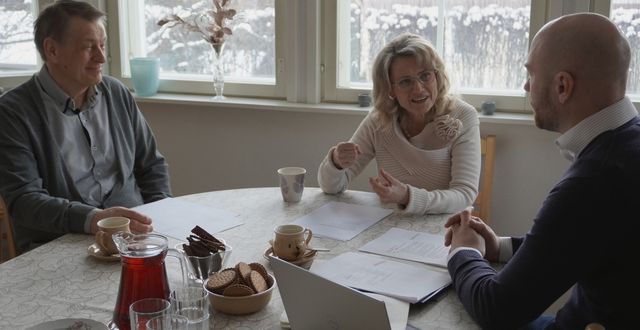
Paivi and Paul

“It’s remarkable,” Päivi says, “how God uses this.” From the beginning, she says, “I had a deep, deep feeling this was in God’s hands, that He was opening a door. There’ve been so many opportunities to testify about Jesus … before these courts, in front of police officers, even to those who vehemently disagree with me. It’s given me a lot of joy.

“I’ve received messages from people who’ve told me that, as they’ve followed the trials and listened to my interviews, they’ve started to read the Bible and pray. They’ve found Christ.

“I got a call from a 22-year-old man who told me that he knew almost nothing about Christianity but was listening to a radio interview where I said, ‘If you want to know Jesus, you can pray, He will come into your life.’ He has been a Christian now for over two years. Jesus came into his life.”

As a lawyer who feels called to defend freedom of religion and speech,” Coleman says, “it’s been the great privilege of my career to be [able] to support and defend Päivi. I’m not exaggerating by saying she is, ultimately, the reason why we exist.

“She’s tough. Really tough. Yet … always smiling, always kind. Over the past five years, I’ve sat through two trials with her, sat around her kitchen table, seen her in every context in between. She’s just such an unbelievably authentic person. The same in every context, whether being cross-examined for her faith, or hosting us for dinner after the hearing.”

During one hearing, Coleman says, “the prosecutor — who, bear in mind, has said horrible things about her and wants to put her in jail — was visibly unwell. And, at one of the breaks, Päivi just went over to sit with her, ask how she was doing, connect with her on a human level.

“She wasn’t doing it for the cameras,” he says. “No one saw it. But I thought, ‘What a remarkable person this is.’ It’s just such a privilege to be called as a ministry to stand alongside her and say, ‘We’ve got your back.’”

“I have received much more during this legal process than I have lost,” Päivi says. “When I was young, I read from those texts where Jesus says that, when they take you in front of courts and kings, you’ll be His witness, and He will provide what to say. I could never have believed I would ever be in this kind of situation. But I think it’s increased my trust in God.

“What I’ve found is that what God has promised, He is faithful [to do]. He really works as He has said. Jesus is alive, and He stands by His word. And He is good.”

Conclusion: The Assault on Freedom of Expression

At the heart of Päivi’s case is a growing trend across Europe: the weaponization of vague and subjective “hate speech” laws to suppress peaceful expression. The implications of this case extend far beyond Finland. What does this mean for ordinary European citizens if a respected parliamentarian can be prosecuted for a tweet?

International law, and that of Finland, guarantees freedom of speech and religion, yet cases like Päivi’s show how these rights are increasingly being violated or reinterpreted to serve ideological ends. If she were to be convicted, it would mark a dangerous shift towards state control over individual freedoms.

The principle at stake is not whether one agrees with Päivi’s beliefs. It’s whether a European democracy can still allow space for diverse opinions in the public square. Once the state decides which views are acceptable and which are not, the door opens to widespread censorship.

Europe’s commitment to democracy demands better. The Finnish Supreme Court now has a decision to make, and the world is watching. Time will tell, but one thing is certain: Päivi Räsänen will not be silenced.

ADF International is honoured to stand by her side, just as we’ve done for the last six years.

Scottish health authority suspend American midwifery student over pro-life Facebook posts

Picture: Marion McKinnon Photography
  • NHS Fife suspended placement of U.S. citizen and Edinburgh Napier midwifery student who raised objection to performing an abortion in Facebook comment  
  • Decision violates right of medical staff and students to free speech and conscientious objection, says ADF UK, providing legal support  
  • U.S. Vice-President Vance raises concerns to Keir Starmer in Washington about UK “infringements on freedom of speech” which affect American citizens 

DUNDEE (28 February 2025) - A midwifery student and mother of three resident in Scotland but from the USA was suspended from her training placement with NHS Fife over comments on a private Facebook forum explaining her conscientious objection to performing abortions.  

“It is concerning that an NHS health board would be reluctant to welcome a student who holds certain beliefs regarding the significance of unborn human life.”

Sara Spencer, 30, was suspended and subjected to a fitness-to-practise investigation as a result of comments made on a private midwifery Facebook group in which she responded to a post asking: “Do midwives have anything to do with abortions, and can they refuse to take part in carrying them out because of their beliefs?” 

Commenting on her treatment, Sara Spencer said:   

“It’s well-known that medical professionals in the UK have a right to conscientiously object to performing an abortion.   

“As a student, I expected to be able to freely engage in discussion among my peers about the grounds for my conscientious objection, and to respectfully debate matters of medical law, ethics, and the philosophy of midwifery care – matters which lie at the heart of our profession. 

“I was shocked by NHS Fife’s response to my expression of legally protected beliefs. It is concerning that an NHS health board would be reluctant to welcome a student who holds certain beliefs regarding the significance of unborn human life.”  

Vance raises concerns over UK impinging on free speech of American citizens

During Prime Minister Keir Starmer’s visit to the White House yesterday, Vice President J.D. Vance highlighted concerns about “infringements on freedom of speech” in the UK, “…which also affect American technology companies and by extension, American citizens”. 

The Prime Minister responded, “we’ve had free speech for a very, very long time in the United Kingdom, and it will last for a very, very long time.”  

Keir Starmer assured U.S. Vice President J.D. Vance that “certainly we wouldn’t want to reach across U.S. citizens, and we don’t, and that’s absolutely right.” 

A right to engage in discussion 

Spencer contributed to a Facebook discussion by noting that there was “a right to refuse to take part [and the] law protects [individuals’] statutory right of conscientious objection” and that she would always personally object to participating in “killing” an unborn child.    

 As a result of complaints about her comments, Spencer was summoned to a meeting with her line manager at NHS Fife, who subsequently turned the matter over to Edinburgh Napier University, which initiated a Fitness to Practise investigation for a) bringing the profession or the University into disrepute b) conducting herself in a manner “detrimental to the safety, dignity, and wellbeing and personal and/or professional reputation of others” c) misusing social media and d) conducting herself in a manner falling below the expectations of the student’s relevant Professional Code. 

 Against the recommendation of the Fitness to Practise officer handling Spencer’s case, NHS Fife suspended Spencer’s placement for the duration of the investigation.  

 ”Sara’s career has been negatively impacted by a cultural prejudice against people with pro-life opinions – present both at her university, and in her workplace.  

 ”It’s clear that, while committed to a number of diversity policies, universities across the country have struggled to uphold true diversity of thought – punishing students who peacefully express their own ideas. Sara’s story points to a need for legislation which reaffirms freedom of speech in these learning environments, if the reputational standards of Scottish universities are to remain intact,” said Jeremiah Igunnubole, Legal Counsel for ADF UK, who supported Spencer.  

With legal support from ADF UK, Sara was subsequently cleared of all allegations, with the university finding “no case to answer”. NHS Fife strongly objected to this outcome, but changed its position following correspondence from the university.    

Freedom of conscience examined by ScotGov abortion law review

 “It should be considered entirely natural and expected that a midwife, focused on delivering life into the world, may have concerns about abortion. It’s for this reason that our laws protect freedom of conscience for all medical professionals, who should never be compelled to act in a way they consider harmful. 

 “The Scottish Government are currently undertaking a review of our nation’s abortion law, including with regard to conscientious objection, led by a panel of “experts” – many of whom have had a career within or around the abortion industry. Sara’s experience should sound an alarm bell about the need to reaffirm freedom of conscience across all public health boards,” commented Lois McLatchie Miller, Scottish Spokesperson for ADF UK. 

Despite being cleared of any wrongdoing, Spencer’s professors at Edinburgh Napier University have continued to issue warnings to her about her social media use, referring to Spencer’s comments regarding her pro-life beliefs as “inappropriate.” 

With support from ADF UK, Spencer is now seeking acknowledgement of the rights to both conscientious objection and freedom of expression of protected beliefs from NHS Fife, as well as assurances that they will not discriminate against those students and professionals who express pro-life views in the future.  

Images for free use in print or online in relation to this story only

PICTURED: Sara Spencer (photo credit: Marion McKinnon Photography); Lois McLatchie Miller; Jeremiah Igunnubole

Mexican Government Ignores Inquiry from International Human Rights Body Into Politician Censored and Convicted for Twitter/X posts on Gender

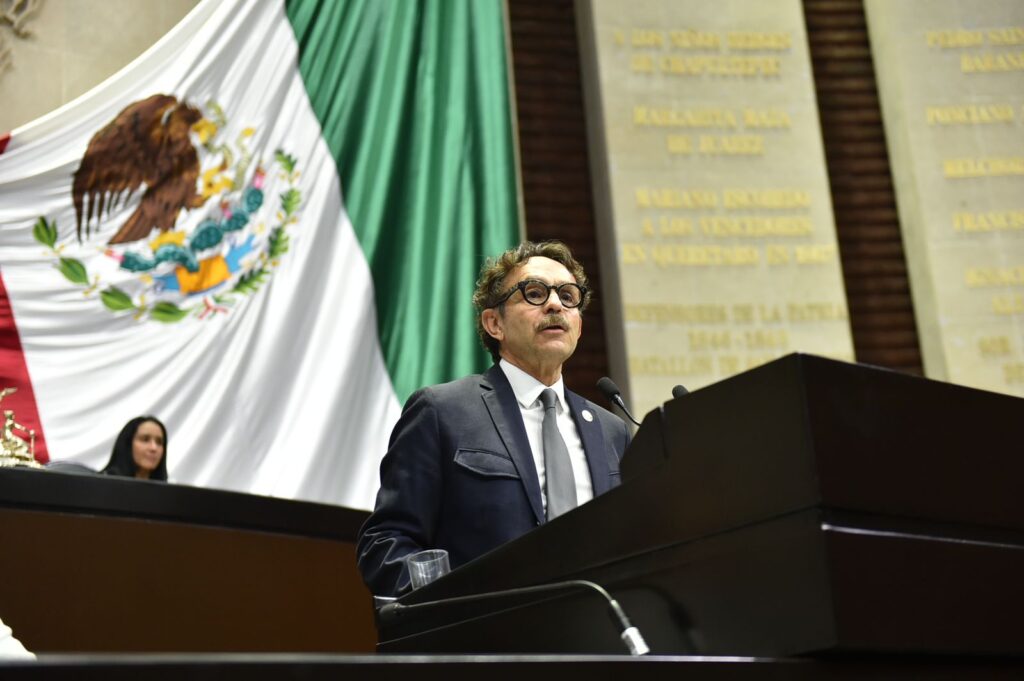
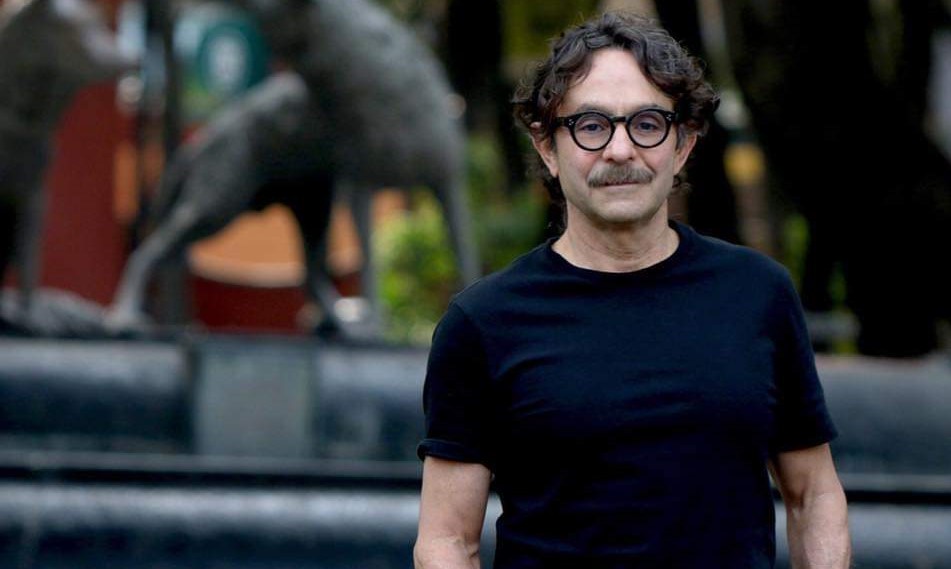
Mexican Congressman Gabriel Quadri.
  • Former Mexican congressman and presidential candidate Gabriel Quadri was convicted as a “political violator against women” for Twitter/X posts on gender. 
  • ADF International represents Quadri before the Inter-American Commission on Human Rights; Mexico has failed to respond, prompting expedited consideration before the body. 

WASHINGTON, DC (18 February 2025) Gabriel Quadri, a former congressman and presidential candidate from Mexico, was convicted in May 2022 as a “political violator against women” for posts on Twitter/X expressing concerns about gender ideology. Specifically, Quadri commented that it was unfair for men who identify as women to take spaces in Mexico’s Congress reserved for women. 

The highest electoral court in Mexico ruled that Quadri’s posts were discriminatory and ordered him to delete his posts, issue a compelled public apology, and be registered as a gender-based political violator—censorship measures that infringed on his civil and political rights as a Mexican citizen and breach his human right to free speech. 

Quadri appealed to the Inter-American Commission on Human Rights with the legal support of ADF International, demanding that the Mexican state be held accountable for violating his freedom of expression. In March of last year, the Mexican government was prompted to respond to the case. Failing to do so, the Commission has announced that Quadri’s case will be moving forward without Mexico’s response.  

“Mexico’s failure to respond to Gabriel Quadri’s case before the Inter-American Commission on Human Rights evinces a clear disregard for the basic human right to free speech. We are pleased that his case nevertheless will progress, and are hopeful that Mexico will be held accountable for its obvious human rights violations,” stated Julio Pohl, legal counsel for ADF International. 

“The Mexican government has seriously violated Quadri’s free expression rights, and it’s time for the Commission to act decisively for justice in his case and in defense of the free speech rights of all Mexicans.” 

You are currently viewing a placeholder content from YouTube. To access the actual content, click the button below. Please note that doing so will share data with third-party providers.

More Information

“Gender based political violence” conviction  

Mexico has in place a law requiring equal representation of men and women in Congress. Quadri’s Twitter/X posts made the point that it is unjust for males to take advantage of the law to gain access to political positions designated for women.   

On February 8, 2022, Quadri posted on Twitter/X: “We should legislate to prevent that men that make themselves pass as women compete unfairly against women in organized sports, and that they do not usurp the political electoral positions that belong to women…”   

On February 16, 2022, he posted: “Let it be clear. In the House of Representatives of the 65th Legislature there is no parity between men and women. There are 252 men and 248 women, thanks to trans ideology and/or gender ideology. Men enter through the back door to (once again) displace women…”   

Salma Luévano, a MORENA then-member of Congress who identifies as a transgender woman, filed a complaint regarding the posts before the National Electoral Institute resulting in Quadri’s conviction. Luévano gained notoriety for fomenting unrest within Mexico’s Congress, including an incident where the president of the chamber was physically wrestled from his chair amidst calls to expel Quadri from the chamber.   

The Court ordered the following punitive measures following Quadri’s conviction: requirements to (i) delete the tweets, (ii) issue a public apology drafted by the Court and post a summary of the ruling on Twitter/X for 15 days, at two set times per day, (iii) complete two courses on gender-based violence and transgender violence, and (iv) be listed as a “gender-based political violator” on a national registry for two years and nine months.   

With the exhaustion of domestic remedies, ADF International petitioned the Inter-American Commission for justice for Quadri in December 2022. In January 2024, more than a year from the filing, the Commission called on the government of Mexico to respond. Now in 2025, after a failure by the Mexican government to respond, the case is moving forward within the Commission. 

Former Mexican Congressman Rodrigo Iván Cortés also was convicted for “gender based political violence” for social media posts. His case is pending before the Commission.     

Images for free use in print or online in relation to this story only.

As Rumble Returns to Brazil, International Free Speech Expert Investigates Brazilian Censorship Crisis with Visit

Brazil censorship
  • Rumble returns to Brazil just before Special Rapporteur for Free Expression meets with Brazilian lawmakers to investigate Brazil’s free speech violations.  
  • ADF International is representing five Brazilian lawmakers before the Inter-American Commission, asking the body to hold Brazil accountable for egregious censorship. 

You are currently viewing a placeholder content from YouTube. To access the actual content, click the button below. Please note that doing so will share data with third-party providers.

More Information

BRAZIL (17 FEBRUARY 2025): The Inter-American Commission on Human Rights’ Special Rapporteur for Free Expression, Pedro Vaca, conducted an official visit to Brazil this week to investigate ongoing free speech violations by Brazilian authorities. The investigation follows multiple filings with the Commission as a result of escalating state censorship in the country, dating back to 2019, reaching a head in September with the suspension of X (Twitter). 

Vaca met with Brazilian lawmakers, whose censorship case is represented by ADF International before the Inter-American Commission. His visit follows the return of Rumble, a free speech video platform, to Brazil on February 9th. The platform had withdrawn its services in the country due to censorship demands.  

Julio Pohl, legal counsel for ADF International, stated:  

“Every Brazilian has the human right to free speech, but the fact is that millions of Brazilians have been subjected to unlawful censorship. The Special Rapporteur’s visit to Brazil signals that Brazil’s egregious human rights violations have not gone unnoticed. While the return of Rumble is an excellent step, there is significant work to be done. Censorship has no place in a free society, and it’s time for the Inter-American Commission on Human Rights to exercise its authority to hold Brazil accountable for the clampdown on free speech.” 

Marcel van Hattem, member of the Chamber of Deputies for Brazil and one of the legislators who filed the petition, commented:  

“We must continue to push back against censorship in our country, and put a stop to those who are abusing their power. What we have seen time and again in Brazil is an egregious silencing of political voices, citizens, journalists, or anyone who might share different viewpoints from Judge Alexandre de Moraes, President Lula da Silva, or others in control. We can’t afford to lose Brazil to authoritarianism, and I am grateful to the Special Rapporteur for taking an urgent look at this crisis. These attempts to silence and censor cannot be allowed to stand.” 

Freedom of speec

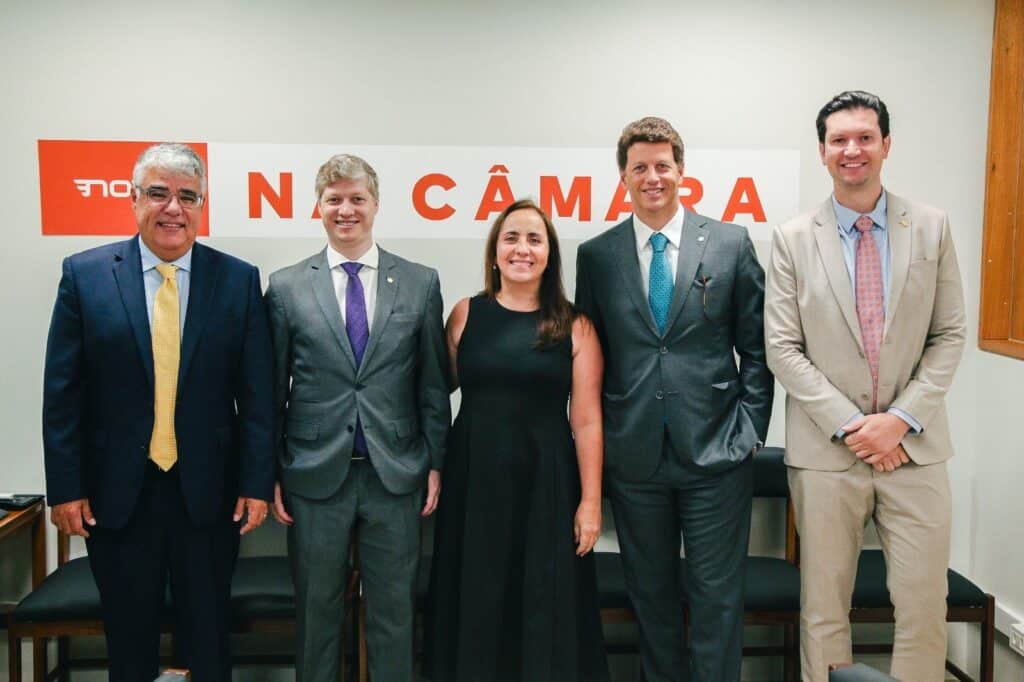
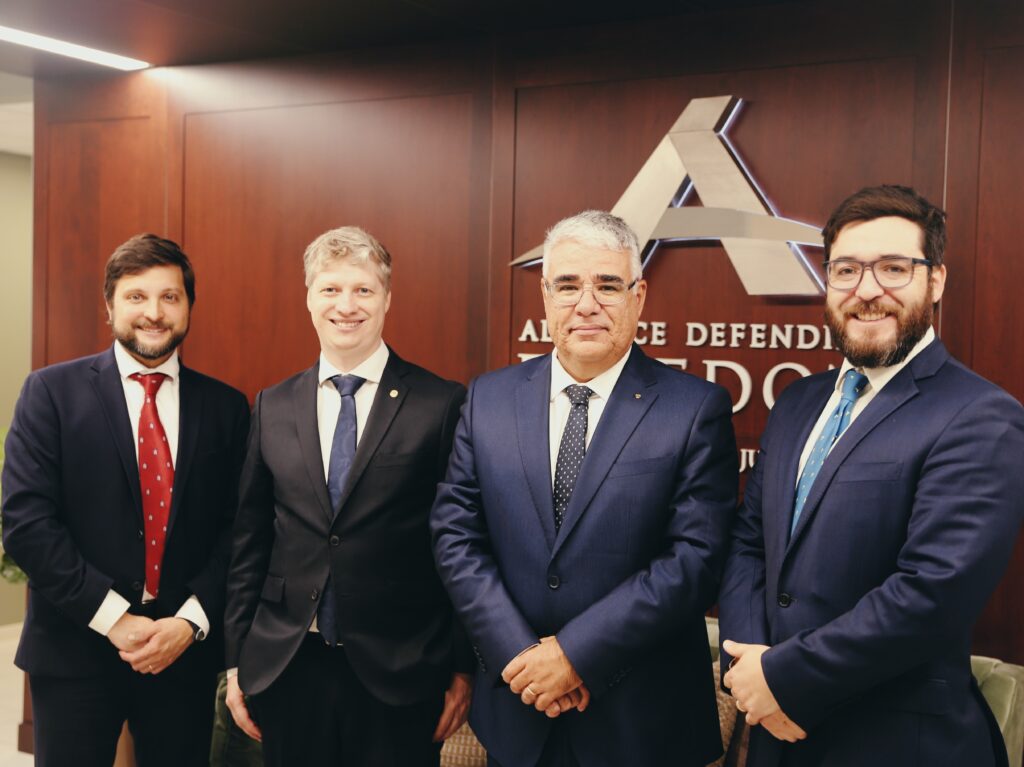
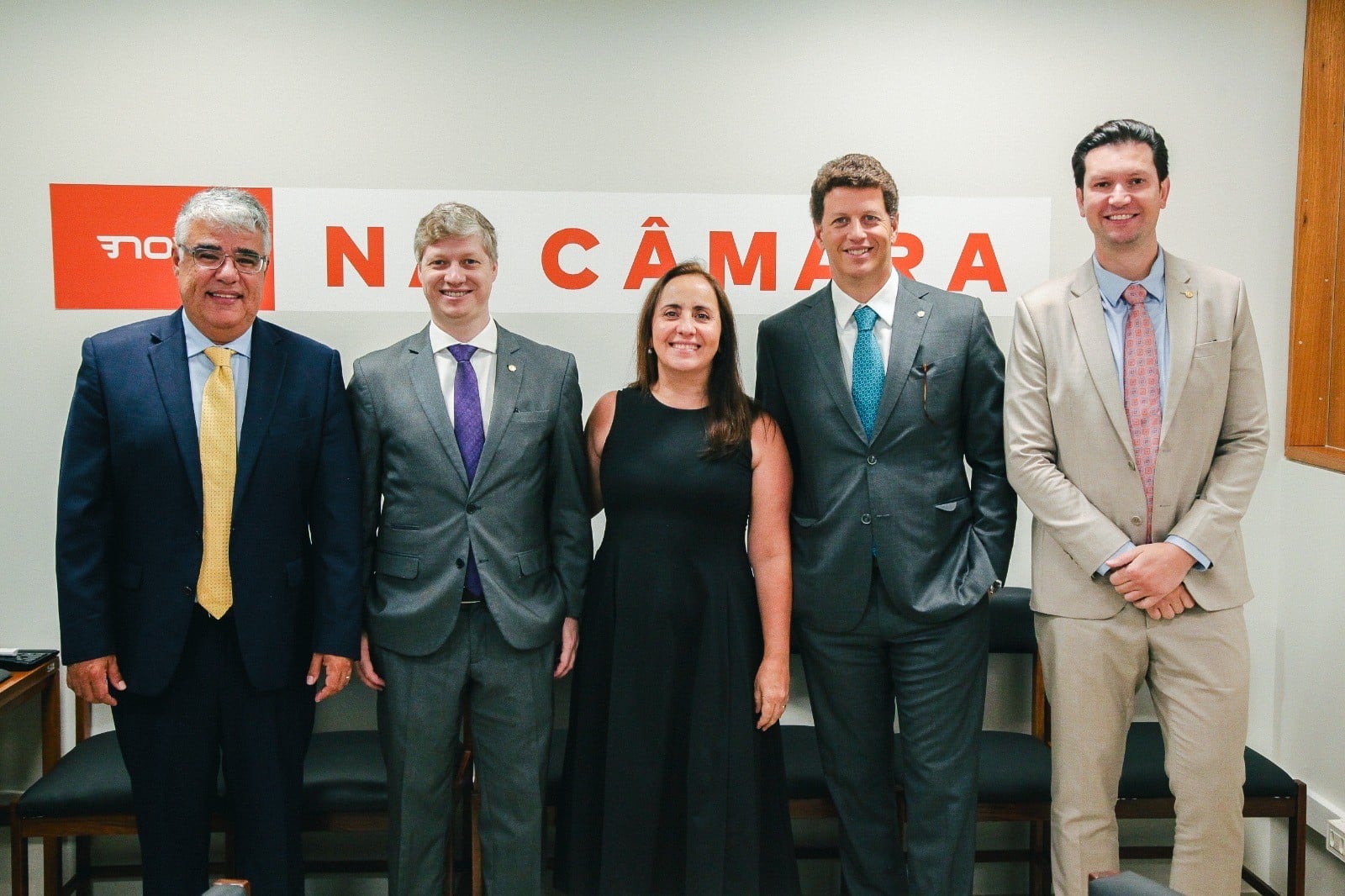
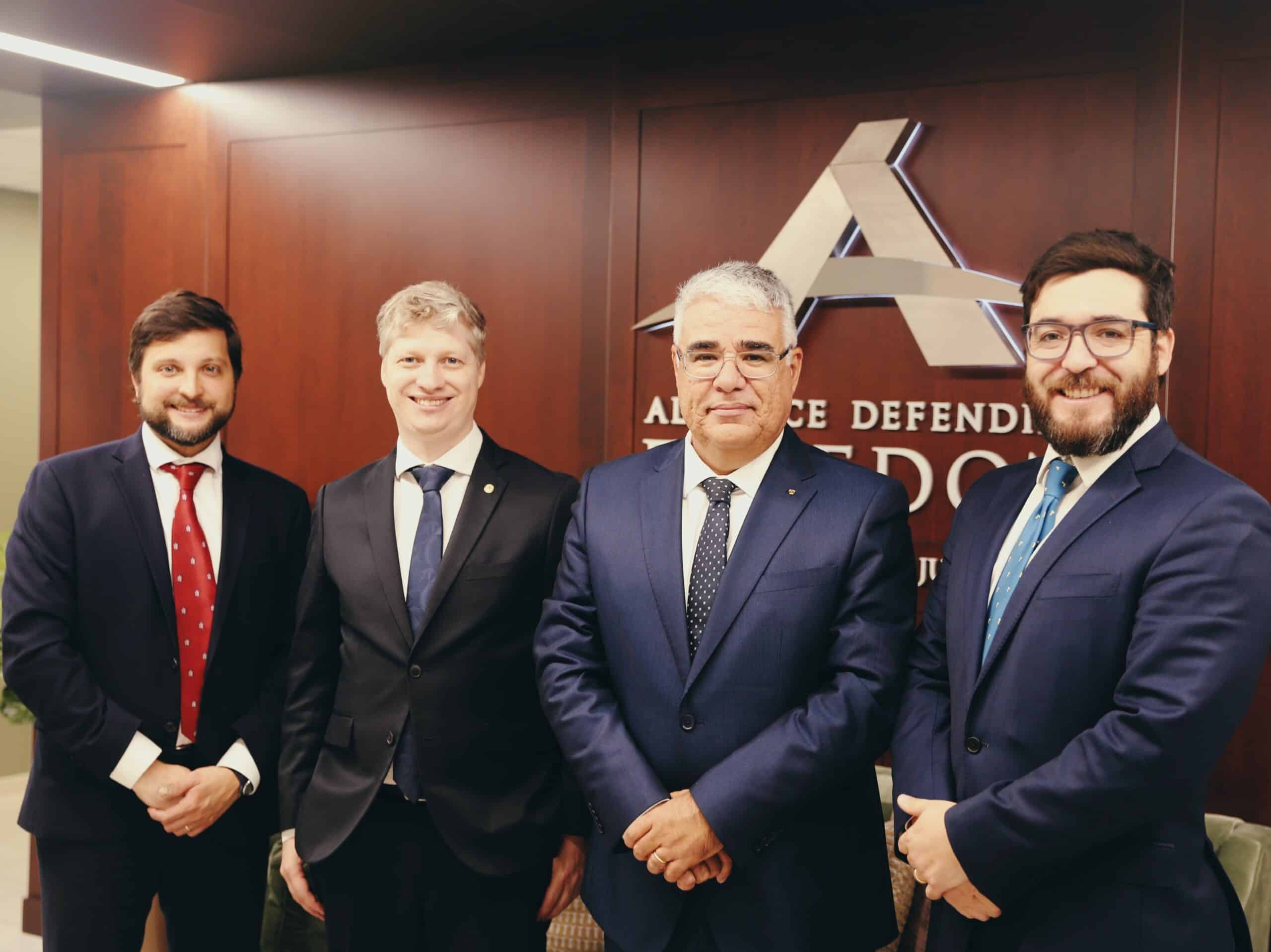
Left to right: Senator Eduardo Girao, Members of the Chamber of Deputies Marcel Van Hattem, Adriana Ventura, Ricardo Salles and Gilson Marques.

The Commission has jurisdiction over Brazil as a State Party to the American Convention on Human Rights. The American Convention robustly protects freedom of speech. 

Images for free use in print or online in relation to this story only.

European Politicians Call for Social Media Censorship and Attack X and Meta’s Free Speech Policies as ‘Threat to Democracy’

  • X-owner Elon Musk accused of being in ‘conspiracy’ with ‘populists and the far right’ during debate at the Council of Europe

  • UK Labour MP called out by MEP for criticising Mr Musk and Meta’s free speech policy and for voicing ‘support for Britain’s notoriously heavy-handed prosecutions for social media posts during last summer’s riots’

  • ADF International executive director Paul Coleman: ‘We are living in a new bipolar order of speech’ between Europe and USA

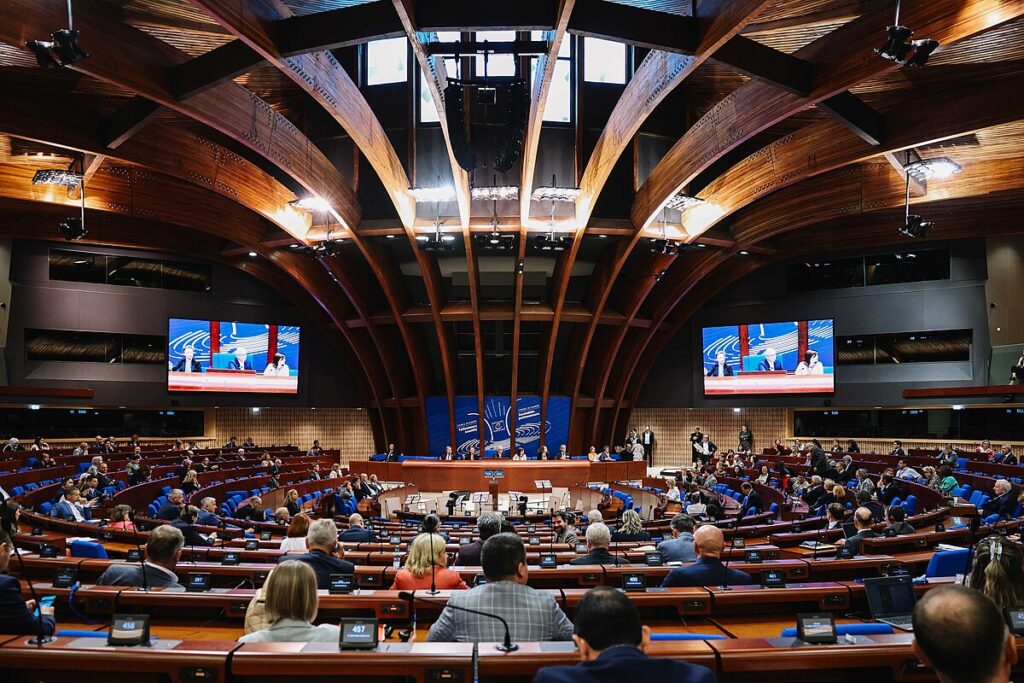
STRASBOURG (1 February 2025) European politicians on Thursday called for social media censorship to “protect democracy” and criticised X and Meta’s free speech policies during a debate at the Council of Europe.

Politicians at the Parliamentary Assembly of the Council of Europe (PACE) called for censorship, in the form of tackling so-called “misinformation”, “disinformation” and “hate speech” online, and voted in favour of a report on social media content regulation.

This follows the European Union last week doubling down on online censorship through the Digital Services Act (DSA), with the same justification of “protecting democracy”.

During Thursday night’s debate, Elon Musk and Mark Zuckerberg were singled out as threatening democracy with their free speech policies.

Belgian politician Christophe Lacroix said: “Why is Elon Musk in the US government?… There is a conspiracy, in any case a conjunction of interests between populists and the far right and the billionaire owners of social networks to effectively interfere in the electoral process.”

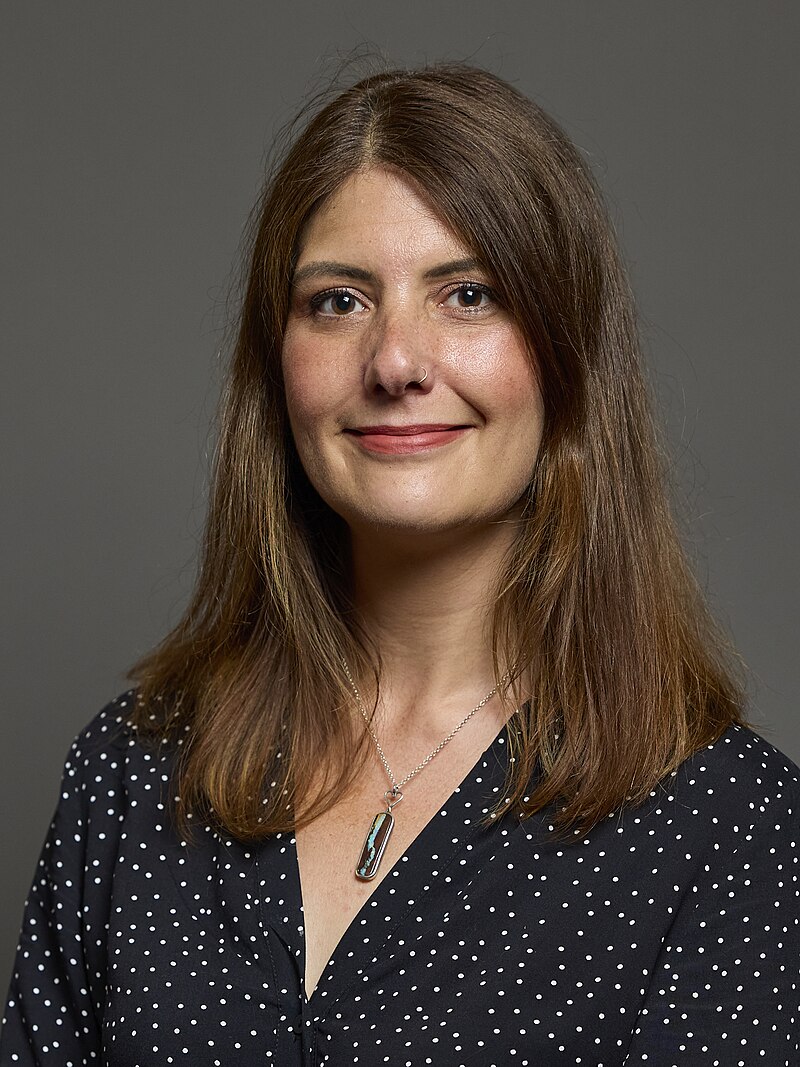
UK Labour MP Cat Eccles said Mr Musk’s “rise of influence” was “something we should all be worried about” and criticised Meta for its new free speech policy, which she characterised as “abandoning fact checking”.

She also indicated support for the notoriously heavy-handed prosecutions for social media posts during Britain’s riots last summer, saying: “While we must value freedom of expression, we must remember that it does not protect individuals from the consequences of their actions. In the UK we saw this play out recently with the horrendous Southport murders last summer and subsequent riots, with people arrested and charged for inciting hatred and violence on all sides.”

French politician Sandra Regol said free speech online posed a threat to “our democracy” and “diversity”.

She said: “We’ve heard a lot about freedom of expression. It’s supposed to be the guarantor of this diversity, it’s supposed to be the guarantor of our democracies and, in a crazy, absolute reversal of values, it’s now the tool that’s destroying this diversity.”

Three amendments were proposed in Thursday’s debate to preserve freedom of expression and they were all rejected.

But an amendment to the report calling for collaborating “with journalists and fact-checking organisations to effectively combat disinformation” was adopted by two-thirds majority.

This puts Europe further at odds with the US regarding free speech, after President Trump last week signed an executive order to end federal government censorship. 

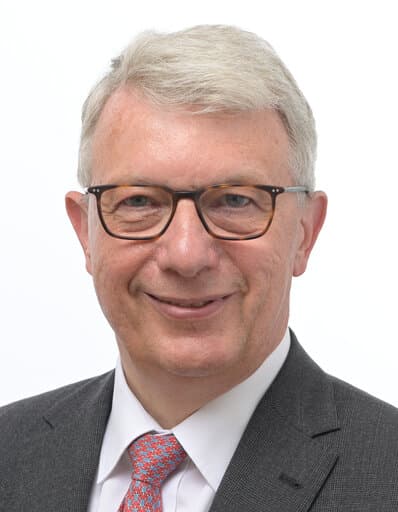
Luxembourg MEP Fernand Kartheiser said:

“Free speech is under serious threat in Europe. It was deeply concerning to see politicians at the Council of Europe calling for online censorship in the name of ‘protecting democracy’.

“Democracy is impossible without free speech, but for some reason, too many politicians, including from the UK, can’t seem to grasp this.

“Labour MP Cat Eccles voiced support for Britain’s notoriously heavy-handed prosecutions for social media posts during last summer’s riots in the country.

“European politicians should consider how their support for censorship and their attacks on the free speech policies of American citizens Elon Musk and Mark Zuckerberg’s platforms will affect our relationship with our vital ally the United States.

“The US has made its commitment to free speech clear and US Vice President JD Vance already threatened last year to withdraw US support for NATO if the EU censors X.

“For the sake of truly preserving European democracy and also good relations with America, all attempts to impose censorship in Europe, including through the Digital Services Act, must end.”

Paul Coleman, executive director of ADF International, a global organisation dedicated to protecting fundamental freedoms, including at the European institutions, stated:

“We are living in a new bipolar order of speech. On the one hand, Europe is doubling down on censorship, while the US is recommitting to its free speech heritage.

“This will usher in an unprecedented era of tension within the West itself over this most basic of human rights, and it is the responsibility of all who value freedom to side with the protection of free speech.”

EU doubled down on social media censorship with DSA last week

Last week, the European Commissioner in charge of enforcing the DSA, Henna Virkkunen, announced a number of measures to further crack down on speech, including doubling the number of staff working on enforcement from 100 to 200 by the end of 2025.

The Digital Services Act (DSA), which came into full force in February 2024, is an EU regulation that aims to tackle “misinformation”, “disinformation”, and “hate speech” online.

By requiring the removal of so-called “illegal content” on social media platforms, it censors free speech both within and outside the EU and could even affect the speech of US citizens online.

On the DSA, Mr Coleman commented:

Last week, the European Commission made clear that it will be increasing its efforts to suppress speech, arguing that the Digital Services Act is needed to ‘protect democracy’ from so-called ‘misinformation’, ‘disinformation’ and ‘hate speech’ online.

“As we saw clearly from Thierry Breton’s letter to Elon Musk this summer, warning him not to breach the DSA ahead of his interview with Donald Trump, the DSA will be used to censor views disfavoured by those in power.

“The DSA poses a grave threat to the fundamental right to freedom of expression, guaranteed to every person under international law. It is not the place of any authority to impose a narrow view of acceptable speech on the rest of society.

“The effects of the DSA will not be confined to Europe. There are legitimate worries that the DSA could censor the speech of citizens across the world, as social media companies could regulate their content globally to comply with European standards.”

Other measures announced by Commissioner Virkkunen included making a previously voluntary code of conduct on “illegal hate speech online” legally binding and advancing a framework called the European Democracy Shield (EDS).

The EDS uses fact checkers and NGOs to combat so-called “foreign information manipulation, interference, and disinformation”.

Under the DSA, social media platforms can face massive fines of up to 6% of global annual turnover for failing to remove so-called “misinformation”, “disinformation” and “hate speech”.

Images for free use in print or online in relation to this story only

Facebook’s Commitment to Winding Back Censorship

Zuckerberg announces censorship windbacks

Practice what you preach, allow free speech

Zuckerberg announces censorship windbacks

After we – and many other free speech groups – spent years sounding the alarm on the suppression of open conversation online, Mark Zuckerberg has this week committed to winding back censorship across all Meta platforms – including Facebook, Instagram, and Threads.

In a monumental announcement, the CEO admitted that the third-party “fact-checkers” employed to moderate content on Meta were “too politically biased”, and that it’s “time to get back to our roots around freedom of expression.”

This isn’t just good news for Instagrammers and influencers. It marks a sea change in the public landscape, indicating an expectation that our right to free speech will be honoured—whether on or offline.

We can celebrate this important milestone and will be watching closely to see if Zuckerberg follows through on his promises. But at ADF International, we’re still keenly aware that the threat to free speech comes not only from privately run internet platforms but also from governments.

Our Cases of Online Censorship

Take Päivi Räsänen. This Finnish member of parliament will soon be heading to a criminal trial at the Supreme Court because of a Bible-verse tweet she posted in 2019. It wasn’t a social media platform that censored her Christian view—it was the state authorities. The case is due before the Finnish Supreme Court this year.

Or take Chris Elston, a.k.a viral internet sensation Billboard Chris. Last February, he posted about his disapproval of the WHO’s selection of an infamous transgender activist to be on a panel setting guidelines for global transgender policy.

It wasn’t a social media platform that decided that his opinion shouldn’t be heard—it was the Australian authorities. We’re supporting his fight for free speech as he goes to court in March, alongside “X,” who wants to be able to host his viewpoint without government interference.

It’s easy to become discouraged as we live through an era where speaking the truth can land you in legal trouble. But this week, we mark yet another clear indication that we’re moving the needle in the right direction.

Brazilian legislators challenge unlawful state censorship at international body

Brazilian lawmakers and freedom of speech advocates
  • Senator Eduardo Girao & Members of the Chamber of Deputies Marcel Van Hattem, Adriana Ventura, Gilson Marques & Ricardo Salles claim violations of their free speech rights following persistent state censorship in Brazil, including 39-day ban on X (Twitter) ahead of elections. 
  • ADF International, representing legislators before the Inter-American Commission on Human Rights, petitions international body to condemn Brazilian censorship and uphold free speech.  
Brazilian lawmakers and freedom of speech advocates

Left to right: Senator Eduardo Girao, Members of the Chamber of Deputies Marcel Van Hattem, Adriana Ventura, Ricardo Salles and Gilson Marques.

WASHINGTON, DC (20 December 2024) In light of the ongoing state-driven censorship crisis in Brazil, five Brazilian legislators, including Senator Eduardo Girao and members of the Chamber of Deputies Marcel Van Hattem, Adriana Ventura, Gilson Marques, and Ricardo Salles, are challenging the violations of their free speech rights before the Inter-American Commission on Human Rights, represented by ADF International.  

The Commission has jurisdiction over Brazil as a State Party to the American Convention on Human Rights. The American Convention robustly protects freedom of speech, including prohibitions on prior restraint (censoring expression before it has occurred) and special protections for political speech. Article 13 protects the “right to freedom of thought and expression” which includes “the freedom to seek, receive, and impart information and ideas of all kinds… through any other medium of one’s choice… The exercise of the right…shall not be subject to prior censorship… [and] may not be restricted by indirect methods or means, such as the abuse of government or private controls … or by any other means tending to impede the communication and circulation of ideas and opinions. 

The legislators claim violations of their rights under the Convention, including their freedom of expression and the equal protection of the law, as a result of escalating state censorship, dating back to 2019, which recently reached a head with the X (formerly known as “Twitter”) ban.  

In their legal challenge now filed with the Commission, the legislators note that state-sponsored censorship, including the 39-day ban of X, is “disproportionate and of dubious legal basis” and “has affected the conventional rights of the Victims in a direct, particular, and serious way.” 

The petition goes on to say that the country’s X blockade “violated the rights of more than twenty million people in Brazil who are users of the platform, having prevented them from accessing the dissemination and reception of information during that time.” 

Julio Pohl, ADF International’s lead legal counsel on the case, stated: “The world watched as Brazilian authorities blatantly clamped down on the free speech rights of over 20 million Brazilians by shutting down X ahead of the national elections. While the ban was eventually lifted, the fact remains that millions of Brazilians, including the five legislators now taking their case to the Inter-American Commission on Human Rights, were subjected to unlawful censorship during a critical time in their country. Censorship has no place in a free society, and it’s time for the Commission to intervene and condemn the vast and ongoing violations of free speech being perpetrated by Brazilian authorities.” 

You are currently viewing a placeholder content from YouTube. To access the actual content, click the button below. Please note that doing so will share data with third-party providers.

More Information

Julio Pohl & Marcel van Hattem

Marcel van Hattem, member of the Chamber of Deputies for Brazil and one of the legislators who filed the petition, commented:  

“What we have seen time and again in Brazil is an egregious silencing of political voices, citizens, journalists, or anyone else who might share different viewpoints from Judge Alexandre de Moraes or others in control. This is a major violation of all Brazilians’ free speech and expression rights. We can’t afford to lose Brazil to authoritarianism, which is why I am taking my case to the international level with the help of ADF International. These attempts to silence and censor cannot be allowed to stand.”  

Eduardo Girao, Senator for Brazil and party to the petition, stated:  

“Brazil is facing a very serious censorship problem. While our constitution protects our rights to speak and express ourselves freely as citizens of Brazil, Brazilians throughout the country are afraid to share their beliefs for fear of persecution and punishment. We must push back against censorship in our country, and it is my hope that the Inter-American Commission on Human Rights will fulfill its obligation to condemn the human rights violations that are taking place in our country.”  

You are currently viewing a placeholder content from YouTube. To access the actual content, click the button below. Please note that doing so will share data with third-party providers.

More Information

Julio Pohl & Eduardo Girao

State-sponsored censorship 

Censorship in Brazil has been a persistent and escalating problem in Brazil since 2019. The state has targeted conservative voices, including blocking pro-life messages during the 2022 election campaign, which contained views contrary to the pro-abortion position held by then-candidate Lula da Silva.   

On 30 August 2024, Justice Alexandre de Moraes of the Brazilian Supreme Court ordered the “immediate, complete and total suspension of X’s operations” in the country after the platform refused to comply with government orders to shut down accounts which it had singled out for censorship.  The ban was in effect for 39 days. 

ADF International petitioned the Commission to urgently intervene, stating, “The blocking of X in the country is symptomatic of an endemic problem…it has dragged on for more than six years and has caused real damage to Brazilian democracy, producing a chilling effect on the majority of the population who, according to recent surveys, are afraid to express their opinions in public.” 

Elon Musk thanked ADF International for its intervention.  

In September, over 100 global free speech advocates – including former UK Prime Minister Liz Truss, journalist Michael Shellenberger, five US Attorneys General and Senior UK, US, European and Latin American politicians and professors united in an open letter to call for free speech to be restored in Brazil. 

Even with the lifting of the X ban, the state of censorship in Brazil remains severe. 

Left to right: ADF International legal counsel Julio Pohl, Chamber of Deputies member Marcel van Hattem, Senator Eduardo Girao, & ADF International Director of Advocacy for Latin America, Tomás Henríquez

Images for free use in print or online in relation to this story only.

What Is the Censorship Industrial Complex and How is it Affecting Our Free Speech Rights?

The Censorship Industrial Complex and what you need to know

A Global "Censorship Industrial Complex" Demands a Global Response

The Censorship Industrial Complex and what you need to know

What was once confined to dystopian fiction has now become an undeniable reality; censorship has become one of the most pressing issues in our digital age. Under the banner of combating “mis-, dis-, and mal-information,” sweeping laws and regulations are being deployed to muzzle voices and suppress free expression on an unprecedented scale.

At its core, censorship is about power—who has it and who gets to decide what is said and what isn’t. This has led to what can be termed the “censorship industrial complex”—a robust and dangerous alliance of governments, international institutions, tech giants, media outlets, academic institutions, and advocacy groups collaborating to control the flow of information, primarily online.

Much like the “military-industrial complex” that US President Dwight Eisenhower warned about in 1961—an influential alliance between government and defence contractors—the “censorship industrial complex” suggests a similar coalition, this time with the intent to control public discourse. Eisenhower warned that when government and industry become too connected, they end up putting corporate or political interests above the public.

As said in the Westminster Declaration: “We understand that words can sometimes cause offence, but we reject the idea that hurt feelings and discomfort, even if acute, are grounds for censorship.” If we fail to address this growing web of censorship, the right to free speech will be chipped away, piece by piece.

How Global Censorship Laws Impact Free Speech Across Borders

The “censorship industrial complex” operates on a global scale, from the suppression of religious speech and political dissent in authoritarian countries to the increasing censorship of conservative or religious perspectives on social media in democratic countries.

The global fight for free speech has reached a critical point, complicated by the vast web of censorship laws across countries. Speech allowed in one country is restricted or criminalized in another, preventing people from sharing ideas across borders. 

And in democratic countries in Europe and the Americas, the threats to free speech are mounting and severe.

“Hate Speech” Legislation as a Tool for the Censorship Industrial Complex

This year, the Irish government debated a “hate speech” law that, if adopted, could criminalize the possession of “hateful” material with up to five years in prison. This law raised alarm among free speech advocates, who asserted that vague definitions of “hate” could lead to suppressing legitimate discourse.

In June, ADF International briefed Irish lawmakers on the dangers and gathered free speech advocates in Dublin to oppose the draconian bill. While the Irish government signalled it would not proceed with the bill, similar legislation likely will be attempted again in the future.

Similarly, in April, Scotland passed a law criminalizing “stirring up hatred” against protected categories, including transgender identity, with a possible seven-year prison sentence. This law also includes ambiguous terms that could criminalize speech perceived as “offensive”.

Wherever these laws are put in place, the term “hate” isn’t clearly defined, opening the door for anything deemed offensive to be categorized as a “hate crime.”

The free speech crisis is far from restricted to one bill in one country. As we’ve seen, restrictive legislation spreads and with it, the erosion of our fundamental freedoms.

Digital Censorship as a Cornerstone for the Censorship Industrial Complex

A peaceful online statement can lead to criminal charges or even prison time in many parts of the world, and the threat of financial penalties is used to pressure and intimidate tech giants like X to censor unwanted speech, leaving anyone at risk for sharing their beliefs.

ADF International is supporting the legal defences of several individuals whose free speech rights have been attacked at national and international levels. Their cases transcend national borders, emphasizing the international nature of the “censorship industrial complex”.

Our Legal Work Against Digital Censorship

Former Mexican congressman Gabriel Quadri was convicted of “gender-based political violence” for tweets on transgender ideology and fair play in female sports. Civil society leader Rodrigo Iván Cortés was convicted of the same for his peaceful expression. Both were sentenced to publish court-written apologies daily on social media and placed on an offender’s registry.

Finnish Parliamentarian Päivi Räsänen has faced charges, trials, and hours of police questioning since a 2019 tweet quoting the Bible’s Book of Romans, in which she questioned her church’s support of a Pride parade.

Citizen journalist and Canadian Billboard Chris was censored for tweeting the truth that a trans-activist shouldn’t serve on a World Health Organization panel for children. Australia’s “E-Safety Commission” tried to force X to take the post down and when X refused, they forced the platform to geo-block it.

Egyptian Father of five Abdulbaqi Saeed Abdo has spent over two years in prison for being part of a Facebook group created for those interested in converting to Christianity.

In Nigeria, Deborah Emmanuel Yakubu was brutally killed by her classmates after she posted a message in a class WhatsApp group, thanking Jesus for helping her with her exams. Her murder was filmed and widely shared. Rhoda Jatau, who allegedly shared a video of Deborah’s killing, condemning it, was also accused of blasphemy. She spent 19 months in prison before being released on bail. In December 2024, following a two-and-a-half-year legal ordeal, a judge in Bauchi State, Nigeria, acquitted Rhoda Jatau of “blasphemy” charges.

You are currently viewing a placeholder content from YouTube. To access the actual content, click the button below. Please note that doing so will share data with third-party providers.

More Information

“Online Safety” Clampdown in Europe

Two major pieces of online speech legislation were passed in Europe over the last two years: the EU’s Digital Services Act (DSA) and the UK’s Online Safety Act (OSA).

The UK’s Online Safety Act aims to “combat harmful content online” by requiring platforms to moderate it or face penalties. However, it has the clear markings of censorship.

A U.S. Congressional Committee has criticized this law, along with the UK’s recent nationwide “buffer zones” legislation, calling it part of a “tsunami of censorship” threatening free speech in America.

The House Judiciary Committee pressed concerns about free speech in the UK and Europe highlighting on Twitter (X):

“Generally speaking, they require platforms to censor alleged hate speech and harmful content…The UK’s laws mirror or go beyond the EU’s laws & include Orwellian practices to investigate speech.”

The Financial Stakes and the Censorship Industrial Complex

“What do platforms risk if they don’t comply? Penalties are as high as six percent of global revenue from the EU’s DSA and 10% of global revenue from the UK’s OSA. Billions of dollars for most major platforms.

“The Digital Services Act and Online Safety Act enable bureaucrats in the EU and the UK to put platforms out of business. So now, social media companies and their employees are incentivized to overregulate speech on their platforms to preserve their business.”

ADF International’s Executive Director, Paul Coleman, stated, “If British politicians do not act to protect free speech, all other considerations aside, the UK will continue to suffer severe reputational harm on the world stage.”

Award-winning author and journalist Michael Shellenberger recently spoke at the European Parliament about the threats posed to free speech by the DSA at an event attended by ADF International. His message to the EU and President of the Commission Ursula von der Leyen was simple: “Back off your attacks on freedom of speech.”

Our Georgia Du Plessis participated in a roundtable discussion at the Parliament with Shellenberger, MEP Fernand Kartheiser, and former MEP Rob Roos about the DSA and freedom of expression. ADF International is committed to ending the free speech crisis.

Online Censorship Under the Guise of Cybersecurity

Barbados is debating a cybercrime bill that could imprison people for up to seven years for causing “annoyance” or “emotional distress” online.

Under the proposed law, it would be a criminal offense to “publish, broadcast, or transmit data that is offensive” or share content that might subject someone to “ridicule, contempt, or embarrassment.” Even vague notions like “annoyance” and “inconvenience” could lead to prosecution.

Such laws will be used to stifle dissent, intimidate critics, and force self-censorship. The risk? Peaceful expression could be criminalized under the guise of cybersecurity.

We brought this issue before the Inter-American Commission on Human Rights in Washington, DC, emphasizing that freedom of speech is under direct threat.

While governments have a duty to combat real online crimes like hacking or incitement to violence, targeting “annoyance” crosses a dangerous line. These regulations, which are supposedly designed to protect the public, are increasingly being weaponized against the public.

The proposed legislation raises a critical question: who defines what is offensive or annoying? Without clear definitions, enforcement becomes arbitrary and ripe for abuse. History shows us how such vague laws can pave the way for authoritarian crackdowns on free speech.

The chilling effect is real: people self-censor to avoid crossing invisible lines and even face the threat of imprisonment.

Ban of ‘X’ in Brazil

Brazil has also been grappling with extreme censorship, making it one of the Americas’ most restrictive countries for free speech.

In August, Supreme Court Justice Alexandre de Moraes blocked X in the country, citing concerns over “misinformation” and “hate speech” affecting the national elections. He didn’t want Brazilians freely engaging in dialogue online in such a way as to impact the elections, so he abused his office to shut down X.

ADF International filed a petition before the Inter-American Commission on Human Rights about the prohibition, representing five Brazilian legislators who were prevented from reaching their audience of millions ahead of a national election.

In September, over 100 global free speech advocates – including UK Prime Minister Liz Truss, journalist Michael Shellenberger, five US Attorneys General, and Senior UK, US, European, and Latin American politicians and professors united in an open letter to call for free speech to be restored in Brazil.

The United States’ Role in Dismantling the Censorship Industrial Complex

The incoming Trump administration is poised to tackle the global censorship issue.

President Trump’s first major policy statement since his victory outlined his plan to restore free speech. He asserts that this fundamental right has been diluted by federal officials who have worked with tech executives to suppress views they don’t like.

Documents uncovered through lawsuits and released by X owner Elon Musk reveal how US agencies collaborated with social media platforms to remove content.

The US’s approach could have wide-ranging effects on censorship laws worldwide, as the US plays a significant role in setting international precedents around free speech and Internet governance.

The US may encourage other countries to protect free speech and, in so doing, work to end the global censorship crisis.

Conclusion: The Censorship Industrial Complex Threatens Our Freedom of Speech

The “censorship industrial complex” is a network of ideologically aligned governmental, nonprofit, media, tech, finance, and academic institutions that are colluding to censor vast swaths of speech they claim threatens democracy, including speech on a wide array of critical social and political issues.

They are weaponizing terms like “hate” and “misinformation/ disinformation” to censor speakers directly, pressure digital platforms to censor, and threaten to shut down platforms that refuse to bend the knee to censorship demands.

Throughout history, those in power have always sought to censor speech with which they disagree.

We must confront the “censorship industrial complex” and safeguard the right to free speech if we are to ensure a future where ideas can flourish without fear of suppression.

‘Tsunami of censorship’: US congressional committee criticises UK’s abortion centre ‘buffer zones’ and online censorship

Isabel Vaughan-Spruce in 2022.
  • Influential committee makes intervention on alarming state of free speech in UK and Europe
  • Abortion centre ‘buffer zones’ and Online Safety Act in UK criticised
Isabel Vaughan-Spruce in 2022.

LONDON (22 November 2024) – An influential US congressional committee has criticised abortion centre “buffer zones” and the Online Safety Act in the UK as part of a “tsunami of censorship headed towards America”.

“This intervention from the House Judiciary Committee shows the UK is fast becoming notorious around the world for its censorious practices."

The X (Twitter) account for the Republicans on the House Judiciary Committee, who are the majority on the cross-party House of Representatives standing committee, called out this censorship in a thread on the alarming state of free speech in the UK and Europe.

The House Judiciary Committee interviewed Isabel Vaughan-Spruce, a Catholic woman who, supported by ADF International, recently won a payout of £13,000 from West Midlands Police for her two unlawful arrests for silently praying in an abortion centre “buffer zone” in Birmingham. ADF International is a faith-based legal advocacy organisation.

The committee’s X thread also critiqued the Online Safety Act for requiring “platforms to censor alleged hate speech and harmful content”.

ADF International Executive Director Paul Coleman commented: “This intervention from the House Judiciary Committee shows the UK is fast becoming notorious around the world for its censorious practices.

“The incoming administration has made its commitment to free speech clear. If British politicians do not act to protect free speech, all other considerations aside, the UK will continue to suffer severe reputational harm on the world stage.” 

Congressman Darrell Issa, a member of the House Judiciary Committee, said: “The growing attacks on free speech in the US – as well as the UK and EU – pose a direct threat to free people on both sides of the Atlantic. We know that legislation like the Online Safety Act that is said to combat ‘hate speech’ empowers regulators to censor free speech.

“Congressional Republicans understand that these threats to free speech are part of a broader global push by the Censorship Industrial Complex, which includes not only the EU, UK, and other nations but also malign actors here at home. We are committed to confronting this growing threat alongside the incoming Trump Administration to fight against these assaults on free speech within our borders and around the world.”

Reform UK Leader, Nigel Farage MP said: “The crackdown on free expression within the UK is becoming very sinister.

“Our police and government now withhold vital public information and we get censored simply for demanding the truth.

“I will continue to fight this.”

Critique of “buffer zones”

In its post, the House Judiciary GOP said: “What could posting a Bible verse or praying in front of an abortion clinic get you in Europe? A visit from the police—or worse…

“Isabel Vaughan-Spruce was arrested and prosecuted for silently praying. She won her case. Yet still, she receives tickets and other forms of intimidation by police.”

The intervention came shortly after “buffer zones” were introduced around all abortion centres in England and Wales at the end of last month as part of the Public Order Act.

These ban “influencing” someone regarding abortion within 150 metres of an abortion facility. Thankfully, the Crown Prosecution Service has issued guidance saying silent prayer is “not necessarily” a crime and that there must be evidence of overt activity.

However, army veteran Adam Smith-Connor last month became the first person to be convicted for silent prayer in a “buffer zone”. With the support of ADF International, he is appealing his conviction.

Medical scientist Dr Livia Tossici-Bolt also faces trial for holding a sign in a “buffer zone” that said “Here to talk if you want”. 

Critique of Online Safety Act and Digital Services Act

The House Judiciary GOP post critiqued UK online speech legislation and the Digital Services Act, an EU regulation: “Two major pieces of online speech legislation were passed in Europe over the last two years: The EU’s Digital Services Act (DSA) & the UK’s Online Safety Act (OSA).

“Generally speaking, they require platforms to censor alleged hate speech and harmful content… The UK’s laws mirror or go beyond the EU’s laws & include Orwellian practices to investigate speech.”

The committee’s post explained that because of the population and economic size of the UK and EU, regulations that censor speech in those areas can affect the US. For example, companies change their global policies to match anti-speech EU regulations.

Financial penalties also play a role: “What do platforms risk if they don’t comply? Penalties are as high as 6% of GLOBAL revenue from the EU’s DSA and 10% of GLOBAL revenue from the UK’s OSA. Billions of dollars for most major platforms.

“The Digital Services Act and Online Safety Act enable bureaucrats in the EU and the UK to put platforms out of business. So now, social media companies and their employees are strongly incentivized to overregulate speech on their platforms to preserve their business.

“The fight for free expression online is a global fight. The Biden-Harris Administration has stood by silently as foreign countries try to render the First Amendment obsolete.”

Dr Päivi Räsänen

The thread from the congressional committee also highlighted the case of Dr Päivi Räsänen, a Finnish parliamentarian on trial for a tweet expressing her Christian views on sexuality.

With the support of ADF International, Dr Räsänen faces trial at Finland’s Supreme Court for alleged “hate speech”, despite being unanimously acquitted of the charges on two previous occasions.

The House Judiciary GOP added: “If she [Dr Räsänen] loses her case, it could serve as a precedent for other European countries.

“Meaning posting a Bible verse could be soon considered ‘hate speech’ across the EU.”

Images for free use in print or online in relation to this story only

“Buffer zones” to be rolled out in October – silent prayer NOT named as an offence, but law lacks clarity

  • Father of two, who served in Afghanistan, faces day 2 of criminal proceedings TODAY for praying silently in abortion facility “buffer zone”
  • UK Government announce “buffer zones” nationwide rollout 31st October – human rights experts warn “disproportionate” legislation “lacks clarity” 

LONDON (18th September 2024) – The UK Home Office have announced today that a ban on “influencing” within 200m of an abortion facility will commence 31st October 2024.  

The legislation was passed as part of the Public Order Act 2023 under the Conservative government, but has not yet been enforced.

In a press release issued 18th September, the Home Office confirmed that anyone found guilty of breaking the law – including by “influencing” someone within 150m of an abortion facility, will face an unlimited fine. 

"Good law should be clear, consistent and predictable, but the buffer zones legislation set to be enacted is vague and broadly drafted."

Human rights experts warn that the ban on “influencing” is too broad, leaving innocent people open to prosecution for engaging in consensual conversation or even silent thought: 

“Good law should be clear, consistent and predictable but the buffer zones legislation set to be enacted is vague and broadly drafted. By banning “influencing” – a broad and sweeping term – over an area stretching 300m in diameter, the law is wide open to misinterpretation and abuse.  

“In the places where “buffer zones” already exist under local authorities, we have already seen three individuals prosecuted over the past two years, simply for praying silently in the privacy of their own minds. 

“Engaging in silent prayer, or consensual conversation, are peaceful acts protected by human rights law. And whilst the government has heeded calls to refrain from naming these acts as criminal offences, the threshold for criminality remains intolerably unclear. It is now incumbent on the CPS and the College of Policing to provide guidance that reflects existing protections for freedom of thought and speech –  keeping the UK in line with international legal standards. Thoughtcrimes are for 1984 – not 2024,” said Jeremiah Igunnubole, Legal Counsel for ADF UK. 

Despite recent reports that Ministers were considering naming silent prayer as an offence in buffer zone guidance, the government did not ultimately publish such guidance. 

The news comes weeks following a victory for freedom of thought, when West Midlands Police had to pay out £13,000 in settlement for the unlawful arrest of Isabel Vaughan-Spruce, a charitable volunteer who prayed silently near a clinic in Birmingham. 

Day Two of Silent Prayer Trial TODAY, Bournemouth

Adam Smith-Connor, the father and army veteran criminally-charged for praying silently near an abortion facility in Bournemouth, will appear today before Poole Magistrates’ Court for the second day of his trial.

Bournemouth, Christchurch & Poole Council filed the charges on the basis that Smith-Connor was praying within a censored “buffer zone” – an area covering several streets in the town – in which the council have banned various expressions of pro-life or Christian belief, including through offering help to women in crisis pregnancies, or praying. 

You are currently viewing a placeholder content from YouTube. To access the actual content, click the button below. Please note that doing so will share data with third-party providers.

More Information

Read the full text of the Public Spaces Protection Order here. 

The defence contends that a mere thought cannot amount to a crime, and authorities must not criminalise citizens for the opinions or beliefs they hold in their minds on any given public street. 

On the date in question, Smith-Connor prayed silently for approximately three minutes before being approached by police officers. Yet the legal proceedings have continued for almost two years, and the trial is scheduled to take place for three days. 

According to a Freedom of Information (FOI) request in February, the Council has so far run up legal fees – charged to the public purse – in excess of £34k to prosecute an offence carrying a maximum fine of £1k. The cost incurred by the Council has likely doubled in light of recent trial costs.

Nobody should be prosecuted for silent prayer. It is unfathomable that in an apparently free society, I am being criminally charged on the basis of my silent thoughts, in the privacy of my own mind. It’s not different than being tried for a thoughtcrime. 

“I served for 20 years in the army reserves, including a tour in Afghanistan, to protect the fundamental freedoms that this country is built upon. I continue that spirit of service as a health care professional and church volunteer. It troubles me greatly to see our freedoms eroded to the extent that thoughtcrimes are now being prosecuted in the UK,” said Adam Smith-Connor.     

A lack of clarity from police

Smith-Connor’s case has unveiled confusion amongst police officers regarding the permissibility of silent prayer in UK law.  

 In a filmed encounter with police on another occasion in which Smith-Connor had silently prayed in the same spot, officers had informed him that he was not breaking the law, remarking, “this is England and it’s a public place and you’re entitled to do that.” 

WATCH THE INTERACTION HERE.

Images for free use in print or online in relation to this story only

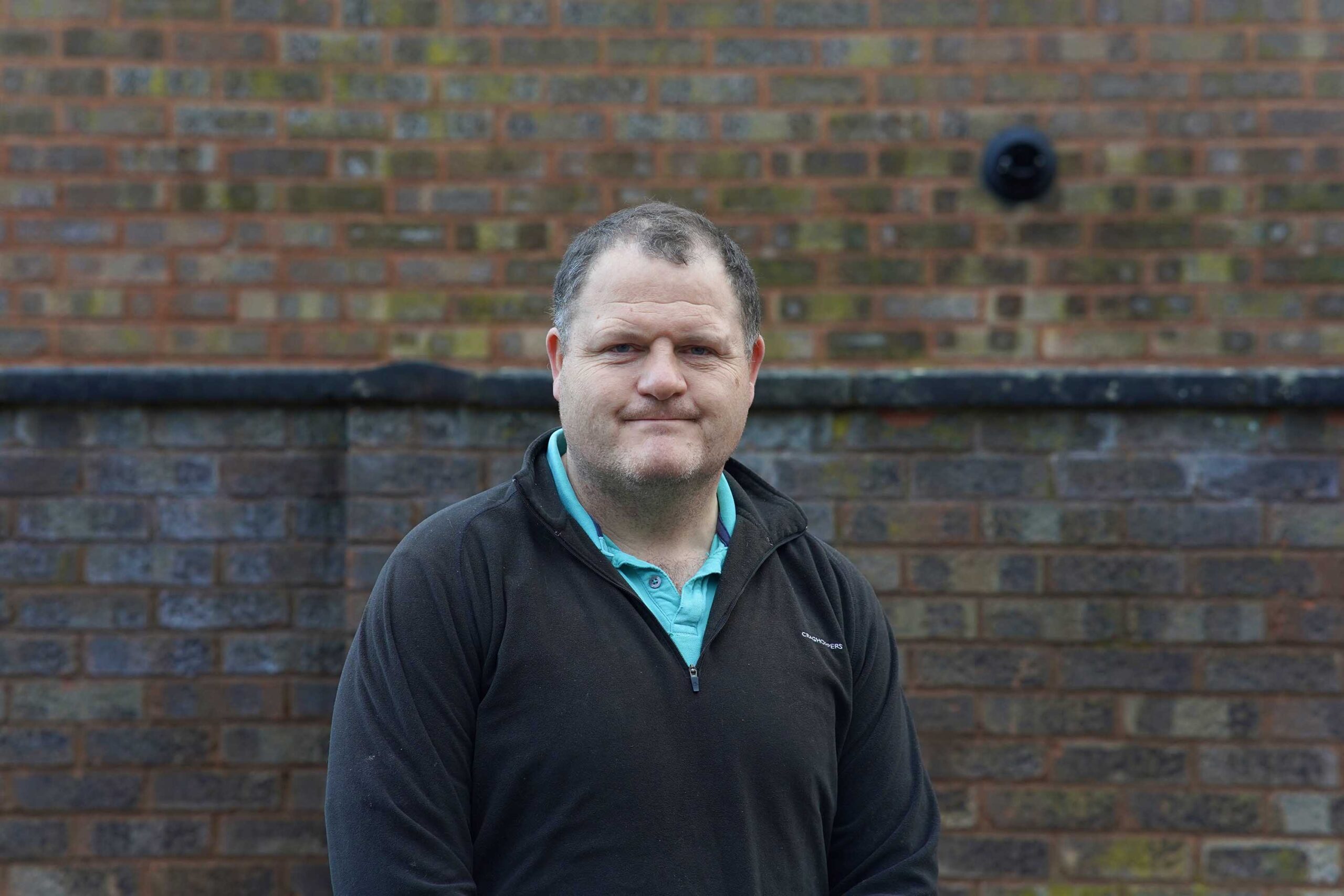
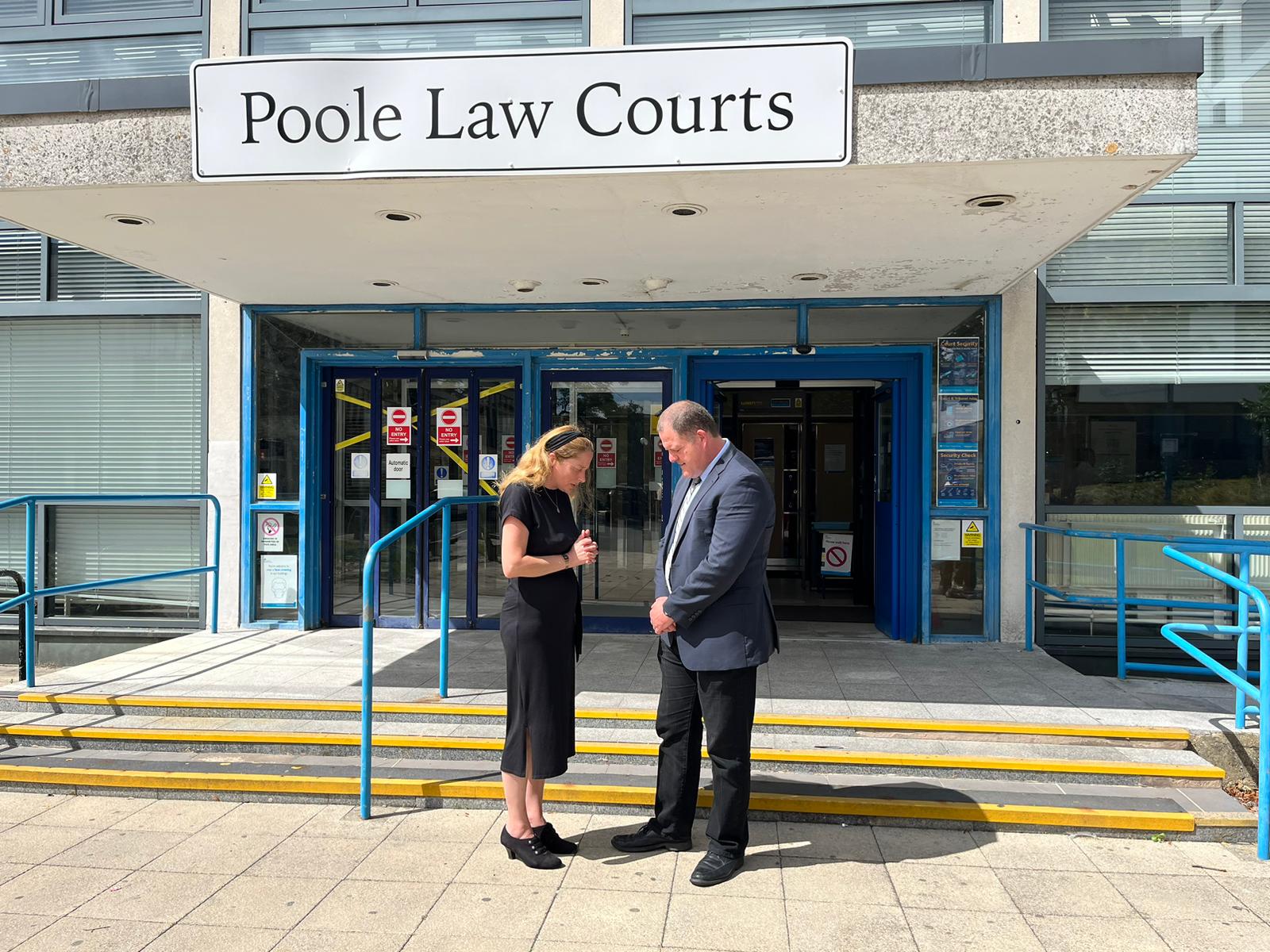
Pictured: Adam Smith-Connor; Adam Smith-Connor praying outside Poole Magistrates Court with Isabel Vaughan-Spruce; Jeremiah Igunnubole, ADF UK