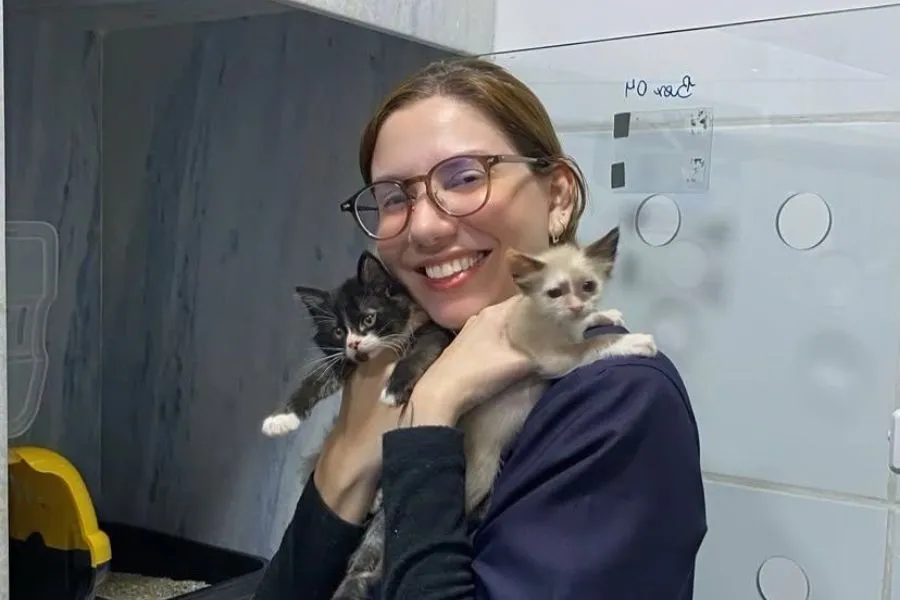
Brazil seeks to reopen case against veterinary student who faced 10 years in prison for “transphobia”
- State prosecution petitions federal court to reopen viral case and exposing Borges to further trial.
- Borges’ case went viral in early 2026 after a Wall Street Journal report and a boost from Elon Musk, who reshared a post about it to his millions of X followers.
- ADF provides legal support to Borges and other similar cases amidst Brazil’s ongoing censorship crisis .

BRASÍLIA (21 OCTOBER 2026) — After a previous dismissal of all charges, federal prosecutors in Brazil have filed a special appeal to reopen their case against Isadora Borges, a veterinary student who previously faced up to 10 years in prison for expressing her views on gender ideology on X. The prosecution has petitioned the court to review the previous decision, and if successful, Borges will once again be on trial, facing the same prison sentence.
“It is terrifying to know that my case could reopen and that I may once again face time in prison, but it is important to me that I always speak the truth. Too many Brazilians have been criminalised or bullied into silence out of fear they will be punished for ‘transphobia’. When we say men cannot become women, we are not spreading hate or targeting anyone; we are stating a biological fact. I hope the court will uphold its previous decision and that my case will go on to stand for our right to speak freely.”
— Isadora Borges
Borges’ case first caught major attention in February 2026 after the Wall Street Journal broke a story on what was happening to her and many other Brazilians who had been accused of ‘transphobia’. Elon Musk soon after reshared a post about her case, causing it to go viral on X. In March 2026, the Federal Regional Court of the 5th Circuit unanimously decided to dismiss all charges and close the case. In its reasoning, the Court stated that Borges’ X comments did not contain any attack, threat, or hostility towards individuals who identify as “transgender,” nor did they incite violence, lacking the intentional element required in criminal law to sustain a conviction for so-called “transphobia”.
Alliance Defending Freedom (ADF) is providing legal support to Borges in defense of her fundamental right to freedom of expression and that of all Brazilians.
“Earlier this year, the court rightfully found that Isadora did nothing unlawful by expressing her beliefs on X. By attempting to reopen this case, the state is showing once again that it will go to great lengths to silence speech it doesn’t like. Accusations of “transphobia” are being rampantly used to censor and scare Brazilians into silence. Isadora’s case is one of many living proofs of this. Brazil’s ongoing crackdown on free speech must stop,” said Julio Pohl, Legal Counsel for Latin America at Alliance Defending Freedom
“The Court’s initial ruling set an important legal precedent that opinions are not grounds for criminal charges for the so-called crime of ‘transphobia’. We urge the Court now not to backpedal on its decision and uphold freedom of expression,” Pohl added.
Background
In November 2020, Borges made two posts on X (then Twitter), peacefully expressing her views on gender ideology. One comment stated that “transgender” women “were obviously born male.” Another stated: “A person who identifies as transgender retains their birth DNA. No surgery, synthetic hormone, or clothing change will change this fact…”
Her comments quickly gained attention online and prompted Erika Hilton, a self-described “transgender” politician, to report Borges for “transphobia” to the federal police. Earlier this year Hilton was elected as president of Brazil’s Women’s Rights Defense Commission (a congressional committee), an act that further exemplifies the spread of gender ideology with a male assuming a key role intended for a woman. Recently, Hilton has been reelected to Congress.
In September 2025, Borges was notified of the criminal charges brought against her. She was accused of two counts of “transphobia,” with each count carrying a punishment of two to five years in prison.
At a hearing in February 2026, a lower court judge indicated that the comments appeared to reflect personal opinions rather than discriminatory intent and granted the defence five days to submit written conclusions, allowing for further consideration of the legal and factual issues before any decision was made.
Borges’ legal team filed a defense before the Federal Regional Court of the 5th Circuit, asking the court to review whether the case could proceed before the lower court judge. The request was successful, and in March 2026, a panel of three judges declared that Isadora’s posts did not constitute a crime, thereby mooting the case before the lower-court judge. Now, with the appeal, the Federal Prosecutor’s are attempting to reopen the case and bring it before the Superior Tribunal of Justice in Brasilia.
Growing Pattern of Censorship in Brazil
Since a 2019 ruling by Brazil’s Supreme Federal Tribunal equated “homophobia” and “transphobia” with the crime of racism, without legislation passed by Congress, individuals across Brazil increasingly have faced criminal investigations and prosecutions for peaceful expression.
In 2025, social media influencer Isabella Cepa faced criminal investigations for her online post about gender ideology. Similarly, Nine Borges (not related to Isadora Borges) has been under criminal investigation for over a year for “transphobia” over content she posted to Instagram.
In another case, Assemblies of God Pastor Douglas Baptista faced criminal charges for authoring a book with a Christian view of sexuality. Charges in his case were dropped, but they remain evidence of the broader, chilling trend of government efforts in Brazil to censor peaceful online expression.
ADF also represents five Brazilian legislators before the Inter-American Commission on Human Rights. The legislators are challenging violations of their free speech rights before the Commission. They claim violations of their freedom of expression as a result of escalating state censorship, which reached a head with the 2024 X ban in Brazil. Censorship in Brazil has been a persistent and escalating problem since 2019.